

Contents
For most Ukrainian MilTech and Defense Tech projects, incorporating a company abroad is not an end in itself. The decision is usually driven by practical business needs: sourcing components from China and other countries, working with European suppliers, opening bank accounts, managing international logistics, and, in some cases, subsequently selling products to foreign customers.
Once the jurisdiction is selected, a more important question arises: what role will the foreign company play, and how will it be integrated into the business’s operating model?
The answer will determine whether the structure can operate effectively for years without raising unnecessary questions from banks, customs authorities, and tax authorities, or whether it will become a source of ongoing compliance risks.
In our previous pillar article, domain article "What you need to know before registering a MilTech company?“ we examined when it makes sense for a Ukrainian MilTech project to establish a company abroad and when such a structure has a genuine economic rationale.
In this article, we move on to the next stage – the practical design of an international business structure. We will first examine one of the most common models for international procurement, then cover structures for raising investment, holding IP, and managing relationships between foreign and Ukrainian companies.
Briefly: an international MilTech business structure should be built around the functions each company actually performs. For procurement, a foreign company may work with suppliers, customs warehouses, logistics providers, and the Ukrainian importer. For investment purposes, it may serve as a holding company, own equity interests and IP, and act as the entry point for investors. In more complex structures, these functions may be distributed among several legal entities.
This material draws on WoBorders’ practical experience in incorporating and providing ongoing support to Ukrainian MilTech, Defense Tech, and hardware projects that work with international suppliers, build corporate and procurement structures across Ukraine, the European Union, and Asian markets, and prepare to engage with foreign partners and investors.
The key regulatory acts on which this material is based are listed at the end of the article.
In this article, Estonia is used only as one example of how such a structure can be implemented. Poland often uses similar structures, particularly when the customs warehouse, logistics provider, customs broker, or part of the operational team is based there. Therefore, most of the principles discussed below apply regardless of the specific jurisdiction chosen.
Building a procurement structure between the EU and Ukraine
This section covers a scenario in which a foreign company purchases components from manufacturers, while a Ukrainian company imports them for use in the subsequent production of finished products.
What a basic MilTech operating model looks like
In simplified terms, the structure is relatively straightforward.
A Chinese manufacturer sells the goods to a foreign company. The shipment then arrives in an EU country and is placed in a customs warehouse. The foreign company subsequently sells the goods to a Ukrainian LLC, after which the products are re-exported to Ukraine for customs clearance and use in manufacturing.
On paper, this may look like a conventional supply chain. In practice, however, it involves several separate legal, customs, logistics, and financial processes, each of which must be properly structured and documented.
A typical model works as follows.
First, the foreign company enters into an agreement with the manufacturer, negotiates the commercial terms, makes payment, and takes ownership of the goods. After shipment, the products are delivered not to a conventional commercial warehouse but to a customs warehouse or bonded warehouse, where they are stored under customs supervision without being released for free circulation within the European Union.
While the goods remain under this customs procedure, they retain their status as non-Union goods. Only then does the foreign company sell the components to the Ukrainian business; the goods are re-exported, and the final import customs clearance takes place in Ukraine.
This sequence of transactions can often make it possible to build an international supply chain without completing a full import of the goods into the European Union.
However, the mere existence of a foreign company does not automatically mean that such a structure will be considered commercially justified.
For a bank, customs authority, or tax authority, the key question will be framed differently: why is there another entity between the Chinese manufacturer and the Ukrainian company in the first place?
If the foreign company merely reissues invoices while all negotiations, financing, supply chain management, and decision-making are effectively carried out from Ukraine, its role will be much harder to justify. Conversely, if the company genuinely manages procurement, works with suppliers, finances production, coordinates with the customs warehouse, manages logistics, and assumes some commercial risk, its economic function becomes clear to all parties involved.
This distinction determines whether the structure is viewed as a fully functioning international business or merely as a formal intermediary between the manufacturer and the Ukrainian company.
Why bringing goods into an EU country does not always mean importing them into the EU
One of the main advantages of a customs warehouse is that goods can be physically located within the European Union without being legally released for free circulation.
For businesses, this distinction is fundamental.
This model is based on the provisions of the Union Customs Code (Regulation (EU) No 952/2013), which provides for special customs procedures, including customs warehousing. While goods remain under this procedure and have not been released for free circulation, they retain the status of non-Union goods.
Council Directive 2006/112/EC on the common system of value added tax (VAT Directive 2006/112/EC) provides a similar approach. It allows special customs arrangements to be applied without import VAT becoming due until the goods are released for free circulation.
Therefore, the physical arrival of a shipment in Poland, Estonia, or another EU country does not, by itself, mean that the goods have been imported into the European Union or that import VAT must be paid at that stage.
If components from a third country are cleared as a standard import into an EU Member State, import VAT becomes due and, depending on the type of goods, customs duties and other mandatory charges may also apply.
If the goods are placed under the customs warehousing procedure, import duties are not payable for as long as the goods remain under that procedure. The VAT treatment depends on the applicable procedure and the rules of the relevant EU Member State.
From a practical perspective, this means that the country where the shipment physically arrives and the country where it is ultimately imported may be different. What matters is not the physical location of the goods, but the customs procedure under which they are placed.
At the same time, this model works only if every stage of transportation is properly structured and documented. If the goods are released for free circulation within the EU, import VAT, customs duties, and other applicable charges will arise under the general rules.
Before dispatch, the logistics route, warehouse status, transit procedure, required documentation, and subsequent re-export process should be agreed with the customs broker.
Why a customs broker should be involved before the goods are shipped
One of the most common mistakes when organizing international procurement is contacting a customs broker only after the shipment has already left China or arrived in Europe.
In practice, this is often too late.
A customs warehouse is not a conventional 3PL operator that receives and stores goods. It operates under a specific authorization from the customs authorities, maintains separate customs records, and is responsible for compliance with the customs procedure under which the goods are placed.
Before signing a contract with the manufacturer, it is advisable to determine whether the specific goods can be placed in the selected customs warehouse and which procedure will apply to their subsequent re-export.
At this stage, the broker will typically help determine:
– whether the selected customs procedure is suitable for the specific goods;
– which HS code will be used;
– who will act as the declarant;
– how the transit procedure will be arranged;
– which documents will be required to complete the customs procedure;
– whether the goods are subject to additional export control requirements or special authorization procedures.
This is particularly important for MilTech, Defense Tech, and advanced electronics manufacturers.
Many components used in UAVs, communication systems, electronic warfare systems, or robotic platforms may contain elements that are not military products in themselves but, due to their technical characteristics, may fall within the scope of export controls or require additional scrutiny during international transportation.
Customs classification is rarely based solely on a product's commercial name. Descriptions such as “communication module,” “electronic unit,” or “UAV component” provide customs authorities with very little information.
For proper classification, the broker may require:
– a datasheet or technical specification for the product;
– a technical data sheet;
– drawings or photographs;
– information on operating frequencies;
– transmitter power;
– supported communication protocols;
– the functional purpose of the product;
– information on the intended end use of the product.
In more complex cases, it may also be necessary to assess whether the goods are subject to the export control regime of the country of manufacture or transit.
The earlier these issues are addressed, the lower the risk of delays after the shipment arrives in Europe. This is why, in international procurement, a customs broker often becomes involved before the first payment is made to the manufacturer, rather than only at the customs clearance stage.
What the document flow should look like
If the supply chain involves China, a foreign company, and a Ukrainian importer, the documentation should support not only the movement of goods but also the economic rationale behind the entire transaction.
This is what banks, customs authorities, and tax authorities most commonly examine.
Each reviews the documentation from a different perspective, but they all seek an answer to the same question: does the declared structure reflect how the business actually operates?
The first document is the contract between the foreign company and the manufacturer.
In addition to standard supply terms, it should include a clear description of the products and their technical specifications, price, settlement currency, payment terms, applicable Incoterms rules, the parties’ responsibilities, warranties, and a list of documents accompanying the shipment.
A separate agreement is concluded between the foreign company and the Ukrainian buyer.
In practice, this document often becomes key evidence that the foreign company performs a genuine economic function. It should therefore not simply replicate the agreement with the Chinese manufacturer. Instead, it should clearly define the role the foreign company assumes within the overall structure.
For example:
– finances the procurement;
– consolidates shipments from multiple manufacturers;
– works with the customs warehouse;
– organizes international logistics;
– arranges cargo insurance;
– oversees production;
– assumes the risks associated with delivery delays or defective products;
– coordinates with the customs broker.
If the agreement does not reflect these functions, regulators may reasonably question what exactly justifies the foreign company’s margin.
It is equally important that all supporting documents consistently describe the same transaction. Invoices, packing lists, transport documents, customs declarations, certificates of origin, and other documents should be aligned with one another.
The product name, quantity, item number, units of measurement, and technical description should not vary from one document to another without an objective reason.
For advanced electronics, the product's technical description is particularly important. A general commercial name is usually not sufficient.
The documents should preferably specify:
– the product’s intended function;
– its key technical characteristics;
– the product composition;
– the intended field of use, including military or dual-use applications;
– the status of the goods – whether they are finished products or components;
– any applicable technical restrictions.
If the goods may be subject to export control rules, additional documents confirming the end user may also be required, such as an End User Statement or End User Certificate. These documents confirm who will use the goods, where, and for what purpose.
For dual-use goods, this is often a key element of international documentation.
However, having the required documents in place does not in itself guarantee that no questions will arise. In practice, consistency between the documentation and the company’s actual business activities is becoming increasingly important.
Correspondence with suppliers, negotiations over procurement terms, internal management decisions, evidence of price approvals, and communications with logistics providers and customs brokers all contribute to the evidence that the foreign company genuinely performs its stated functions rather than merely participating in the supply chain on paper.
Modern international documentation is no longer limited to contracts and invoices. It is a combination of documents and business processes that together demonstrate the economic rationale of the entire structure.
The procurement model is only one scenario for using a foreign company in a MilTech business. If the next objective is to attract an international investor, the structure must address a different set of questions: where the equity interests and key assets are held, who owns the IP, how the investor enters the business, and what role the Ukrainian operating company continues to perform.
Building a MilTech business structure to attract investment
Another reason for establishing a foreign legal entity for a MilTech business is to make it more attractive to investors. Ukrainian MilTech is developing rapidly and attracting increasing investor interest. At the same time, the ongoing war creates additional risks that may constrain foreign investment.
Ukrainian MilTech and Defense Tech projects have significant advantages: unique technologies and developments, the ability to test products under real combat conditions, practical experience, and highly skilled specialists. However, investors assess not only the potential of the business and its technology but also its stability, asset protection, and the clarity of its legal structure.
Establishing a foreign legal entity can help combine the strengths of Ukrainian MilTech with a more predictable, investor-friendly corporate structure.
A foreign company as a vehicle for attracting investment in MilTech
One of the most common structures for attracting international investment works as follows.
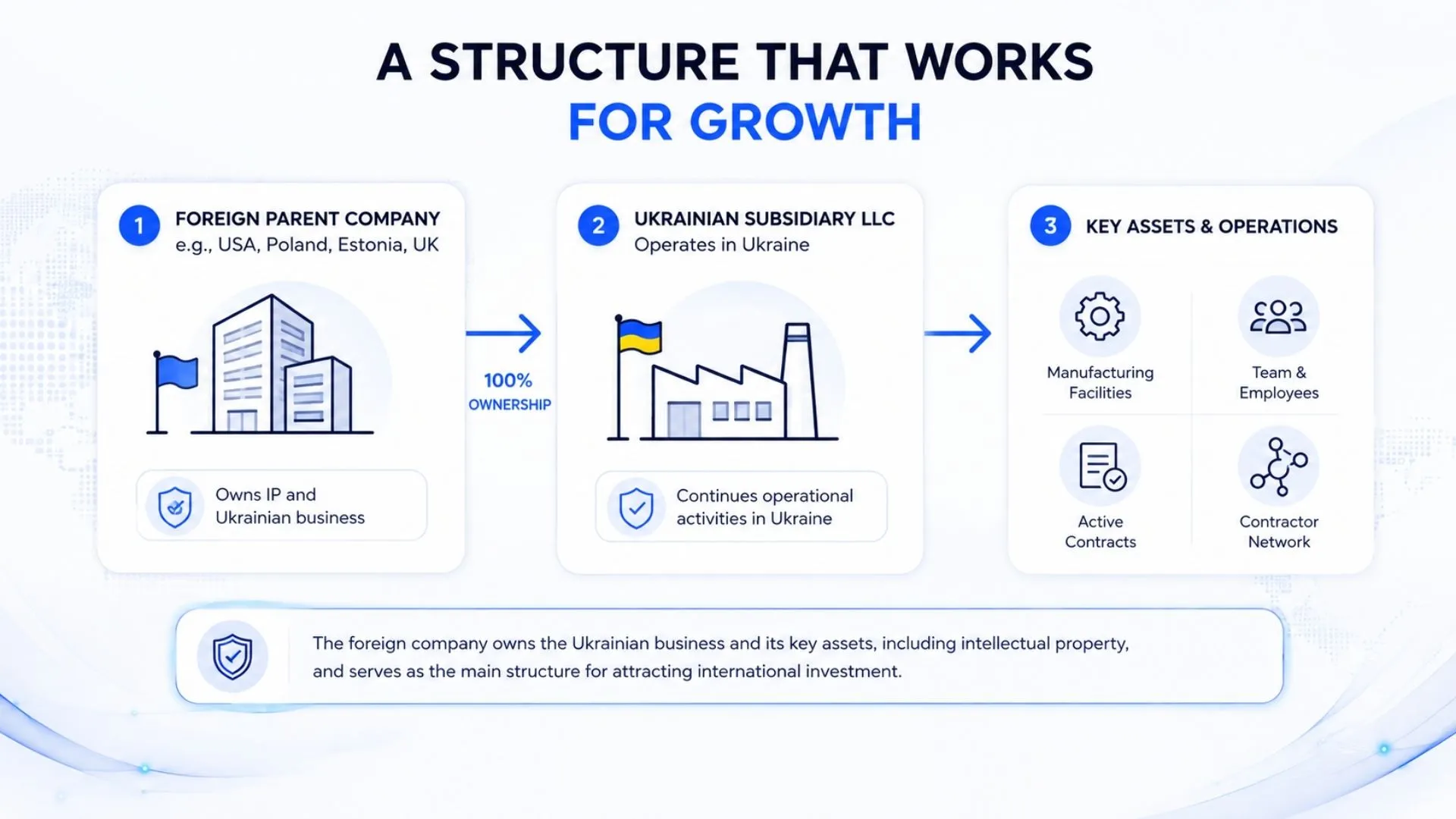
A foreign company is established. Jurisdictions such as the United States, Poland, Estonia, or the United Kingdom may be used. However, the jurisdiction is often selected with a specific investor in mind or based on the requirements of banks, R&D programs, or regulators.
Existing developments, technical drawings, software, patents, and other intellectual property assets are transferred from their Ukrainian owners – whether individuals or legal entities – to the foreign company.
In many cases, these intangible assets are contributed to the share capital of the newly established company. This may require confirming their market value through an independent valuation or audit, depending on the legal requirements of the country of incorporation.
If the Ukrainian MilTech business is already operating and has an incorporated LLC, manufacturing facilities, warehouses, employees, existing contracts, a network of contractors, and other assets, a common solution is to transfer ownership of the Ukrainian company to the foreign legal entity.
As a result, the structure is set up. The foreign company then owns the Ukrainian business and its key assets, including intellectual property, and can also serve as the primary vehicle for attracting international investment.
At the same time, the Ukrainian LLC continues to carry out operational activities in Ukraine: manufacturing products, employing personnel, working with contractors, and performing existing contracts.
Below is a visual example of a clear and investor-friendly structure.
Benefits of a holding structure for investors
The structure should be convenient not only for business owners but also for future investors. Why is this type of structure generally more attractive to investors?
A foreign holding company allows:
– the investor to hold an equity interest in a company incorporated in a jurisdiction that is familiar or understandable to them;
– investor rights to be formalized through corporate documents;
– clear procedures to be established for key corporate decisions;
– minority investor protection mechanisms to be put in place;
– rules to be established for share transfers, investor exits, dilution, M&A transactions, and other corporate events;
– equity incentive mechanisms to be created for management.
For a technology-driven MilTech business, the key asset is often not physical equipment but IP – software, technologies, patents, technical documentation, know-how, and other intangible assets. Investors therefore need to understand where these assets are legally held, who owns them, and under what terms the Ukrainian operating company may use them.
For more information about IP, see our article “Intellectual Property, Contracts and Compliance for Companies Entering the EU Market”.
Investment terms may cover not only the size of the investor’s equity stake but also governance rights, veto rights over certain decisions, procedures for future investment rounds, anti-dilution protection, rules governing share transfers, and mechanisms for the investor’s exit from the business. This is particularly important for MilTech companies, as potential acquirers may include major defense technology companies.
Key investment mechanisms
Once a foreign company is established, it can attract investment through several mechanisms. The best approach depends on the business stage, the type of investor, the amount of funding required, and whether the founders are willing to transfer part of their equity.
Direct investment in the company’s equity
The most traditional option is for the investor to invest funds directly into the foreign company in exchange for an equity stake.
For example, the founder owns 100% of the foreign company. The investor contributes €1 million and receives a 20% equity stake, reducing the founder’s ownership to 80%.
In this case, the company receives the funds directly and can use them to develop new products, scale manufacturing, hire personnel, or enter new markets. This mechanism is particularly common in venture capital and strategic investment transactions.
Sale of an equity stake by an existing shareholder
Another option is for the investor to purchase an existing equity stake from the founder or another shareholder.
In this case, the seller receives the proceeds rather than the company itself. Therefore, this mechanism does not constitute direct financing of the business but rather a partial exit by an existing shareholder. At the same time, the sale of an existing stake can be combined with a simultaneous injection of new capital into the company. Водночас продаж частини частки може поєднуватися з одночасним залученням нового капіталу до компанії.
Combination of a secondary sale and new financing
In practice, the two mechanisms can be combined.
For example, an investor contributes €2 million: €1.5 million is invested directly in the company as new capital, while €500,000 is paid to the founder to acquire part of their existing equity stake.
This approach enables the company to finance its growth while also providing the founder with partial liquidity.
Convertible loan
At an early stage of business development, the parties may decide not to determine the company’s final valuation immediately. Instead of making a direct equity investment, the investor provides the company with a loan that may later be converted into equity.
For example, an investor provides the company with a €500,000 loan. During the next investment round, this amount is converted into an equity stake on terms agreed in advance.
This mechanism can be particularly useful for startups when it is difficult to determine the company’s valuation at an early stage.
Investment through a dedicated investment vehicle
When several investors are involved, a separate company or investment vehicle may be established through which the investors invest in the MilTech business. This makes it possible to centralize the relationship between the founders and the investor group without creating an overly complex ownership structure directly at the level of the Ukrainian operating company.
When a MilTech business may need multiple foreign companies
It is important to understand that the parent company in such a structure does not have to serve solely as a vehicle for attracting investment. A foreign company may enter into contracts directly with international customers, distributors, and partners, making it easier to enter international markets and sell products outside Ukraine.
Such a structure can also facilitate cooperation with major defense contractors that may have restrictions or internal requirements on engaging with Ukrainian companies and may prefer counterparties incorporated in the EU, the United States, or other familiar jurisdictions.
If a MilTech business plans to enter the EU or US market, it may also use a foreign company as a platform to establish manufacturing facilities, warehousing centers, or final product assembly operations. Localizing production abroad is not always economically justified, but in certain cases it can help diversify risks and reduce the business’s dependence on manufacturing capacity in Ukraine.
In addition, depending on the jurisdiction and the specific program, a foreign company may gain access to local grants, government support programs, R&D funding, and other incentives available to technology and manufacturing businesses. Eligibility for such support should be assessed separately for each country and specific program.
It is also not always advisable to concentrate all functions within a single foreign company. Operating activities, investment, intellectual property ownership, and relationships with international partners may be subject to different legal, financial, and tax requirements.
As a result, a MilTech business structure may consist of two or even several foreign companies rather than a single entity.
For example, one company may serve as a holding company to attract investment and hold equity interests in other companies; a second may work directly with international customers and partners; and a third may own intellectual property or conduct R&D.
This separation allows different business activities, assets, and risks to be more clearly segregated. The specific structure will depend on the business model, the countries in which the company operates, its funding sources, investor requirements, and the applicable regulatory environment.
How to approach structuring a MilTech business
There is no universal international structure for a MilTech business. Its configuration depends primarily on the functions that the foreign company is expected to perform.
For a procurement model, the key considerations include working with suppliers, logistics, customs warehousing, re-export, documentation, export controls, and the economic rationale for the foreign company’s role.
For an investment structure, the focus shifts to equity ownership, where the IP is held, the relationship between the foreign and Ukrainian companies, mechanisms for investor entry, and subsequent corporate governance.
If a single legal entity cannot logically combine all the required functions, the structure may include several companies with different roles.
If the business is still in its early stages, the first step is to determine whether establishing a foreign company is necessary and which jurisdiction to consider. These questions are discussed in detail in our article “What You Need to Know Before Incorporating a MilTech Company.”.
Frequently asked questions about international MilTech business structures
Does a MilTech business need to establish a foreign holding company?
No. The need for a holding company depends on the business model, investment plans, ownership structure, IP location, and the countries in which the business operates. For some projects, a single foreign operating company may be sufficient, while more complex structures may include a separate HoldCo, an operating company, and an IP holding company.
Does bringing goods into Poland or another EU country automatically trigger import VAT?
Not always. If goods from a third country are placed under the customs warehousing procedure and have not been released for free circulation in the EU, they may remain non-Union goods. The tax and customs implications depend on the specific customs procedure, so the structure should be agreed with a customs broker before the goods are shipped.
Can a foreign company own a Ukrainian LLC?
This model is commonly used in international corporate structures. A foreign company may own the Ukrainian operating company, while the Ukrainian LLC continues to handle manufacturing, employ personnel, work with contractors, and perform local contracts.
Where can a MilTech business hold its IP?
Intellectual property may be owned by either a Ukrainian or a foreign company, depending on the business’s corporate, investment, and tax structure. For investors, it is critical to clearly understand who legally owns the software, patents, technical drawings, technical documentation, and know-how, and on what terms the operating companies may use these assets.
Does a separate company need to be formed to attract investment?
Not necessarily. Investors can invest directly in an existing foreign company. However, some structures use a separate holding company or dedicated investment vehicle, particularly where multiple investors are involved, the asset structure is complex, or there is a need to separate operational and investment risks.
Regulatory framework
When building an international structure for a MilTech or Defense Tech business, you must consider the laws of the specific countries through which corporate, financial, and goods flows are structured.
In particular, the model described in this article takes into account:
- Union Customs Code – Regulation (EU) No 952/2013 – the European Union Customs Code.
- Council Directive 2006/112/EC – the common system of value-added tax in the EU.
- Union Customs Code – Regulation (EU) No 952/2013 – the EU Customs Code, Articles 237 and 240, concerning storage procedures, non-Union goods, and customs warehousing, is particularly relevant to the customs warehousing model.
- Export controls on dual-use items in the EU – Regulation (EU) 2021/821. The Regulation establishes the EU regime for controlling exports, brokering services, technical assistance, transit, and transfers of dual-use items.
- Export controls in Ukraine – Law of Ukraine No. 549-IV “On State Control over International Transfers of Military and Dual-Use Goods”.
About this material
Ivan Chebotarov and Anastasiia Hnatyshyna prepared this material based on WoBorders’ practical experience incorporating and supporting international structures for Ukrainian MilTech, Defense Tech, and hardware projects.
We advise on jurisdiction selection, incorporation, and ongoing management of foreign companies; international corporate structuring; relationships between foreign and Ukrainian companies; and models involving international procurement and investment.
Last updated: August 2026.