Contents
Author: Ivan Chebotarov, CEO of WoBorders
This information is current as of October 2026.
CRS (Common Reporting Standard) is an international standard for the automatic exchange of information on financial accounts between the tax authorities of different countries. The Organization for Economic Cooperation and Development (OECD) developed it so countries could receive data on the foreign accounts of their tax residents.
The CRS is applied in most EU countries, the United Kingdom, Canada, Australia, Switzerland, and many other jurisdictions. Ukraine also participates in this exchange.
Information is not exchanged between all countries without exception. For the exchange to take place, relevant agreements must be in place between the jurisdictions.
In Ukraine, the legal framework for implementing the CRS is established primarily by Law No. 2970-IX of March 20, 2023, which amends the Tax Code of Ukraine and other legislative acts.
How the CRS works
Banks, custodians, investment firms, and certain insurance companies subject to CRS requirements verify the tax residency of their clients. This verification applies to individuals, companies, and, in certain cases, the controlling persons of companies.
Each year, financial institutions report information on reportable accounts to their country’s tax authorities. This data is then forwarded to the tax authorities of other jurisdictions with which an automatic exchange agreement is in place.
For example, if a tax resident of Ukraine has an account at a foreign bank, information about that account may be transmitted to the State Tax Service of Ukraine via the CRS. For this to happen, the account must meet the reporting criteria, and the relevant countries must have an exchange agreement in place.
The procedure for verifying accounts and determining their reportable status in Ukraine is regulated by Order No. 282 of the Ministry of Finance dated May 26, 2023 , as amended.
What Data is reported under the CRS
Depending on the type of account and its owner, a financial institution may report:
– the first and last name of an individual or the name of a company;
– the address and country of tax residency;
– the tax identification number (TIN);
– the individual’s date and place of birth in cases specified by the standard;
– the account number and financial institution details;
– the account balance or value at the end of the reporting period;
– information regarding account closure;
– details on interest, dividends, other income, and gross proceeds from the sale or redemption of financial assets, if reportable.
The CRS does not require the disclosure of a complete history of all banking transactions for each account. The scope of the data depends on the account category and the standard's requirements.
Not all foreign accounts are automatically reportable. The account holder’s tax residency, account type, the financial institution's status, and existing exchange relationships between countries are all relevant factors.
The list of activated automatic exchange relationships is published on the official OECD website.
CRS in Ukraine: When did the Automatic Exchange begin?
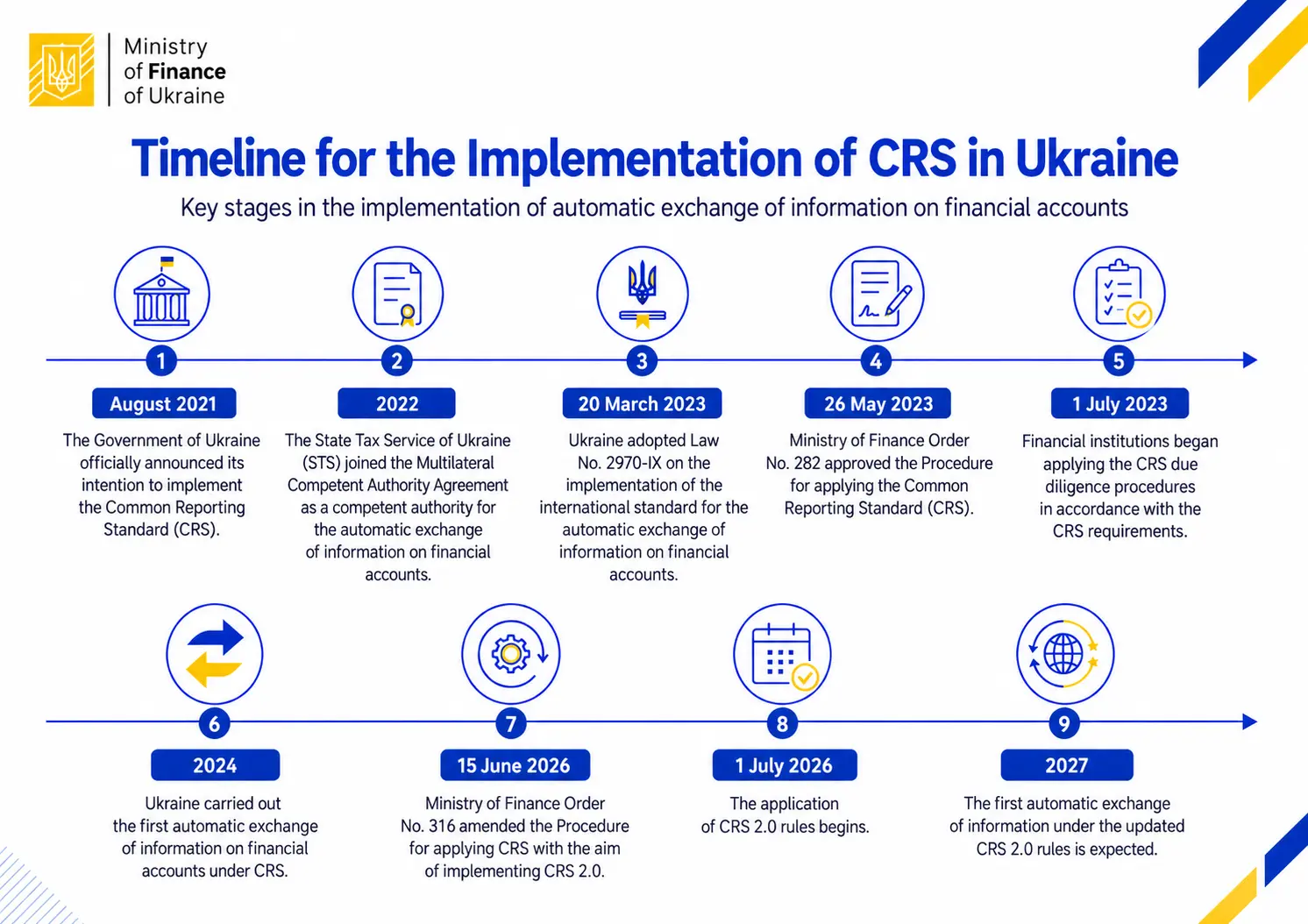
On August 19, 2022, Ukraine acceded to the Multilateral Competent Authority Agreement on the Automatic Exchange of Financial Account Information (MCAA CRS).
On June 28, 2024, the agreement entered into force for Ukraine. The first international automatic exchange took place by September 30, 2024, and covered the second half of 2023.
The dates of accession and the start of the exchange were confirmed in an official announcement by the State Tax Service.
The Ukrainian State Tax Service regularly exchanges financial information with partner countries.
Through the CRS, the State Tax Service can receive information not only about the personal accounts of individuals who are tax residents of Ukraine but also about the accounts of legal entities. Under certain conditions, it also transmits data on the controlling persons of companies.
Can the Ukrainian tax authorities see accounts held abroad?
Yes, the State Tax Service can receive information about foreign accounts held by Ukrainian tax residents through the CRS. However, opening an account abroad does not mean information about it will necessarily be sent to Ukraine.
First, the bank determines the account holder’s tax residency and verifies whether the account meets CRS requirements. If the account is reportable, the bank may transmit the data to the tax authorities of the relevant country and, subsequently, to Ukraine, provided a valid exchange agreement is in place.
How banks determine Tax Residency under the CRS
When opening an account, a bank or other financial institution may ask you to fill out a Self-Certification form—a CRS self-assessment document. In it, the customer indicates the country or countries of their tax residency and the corresponding tax identification numbers.
The bank verifies this information against other customer records. If there are discrepancies, the financial institution may request additional documents or clarification.
For example, if a customer has indicated tax residency in one country but other documents suggest a possible connection to another jurisdiction, the bank may conduct an additional review.
Simply declaring a different country of tax residency is not sufficient if the actual circumstances do not support it.
If, after opening an account, you have changed your tax residency or other information relevant to the CRS, you must notify the financial institution and, if necessary, update your documents. The deadlines for notification are determined by the bank’s applicable rules and procedures.
The requirements for verifying customer information are established by the CRS Implementation Procedure.
CRS 2.0: what has changed in Ukraine
As of July 1, 2026, Ukraine's updated CRS 2.0 rules are in effect. The changes were approved by Ministry of Finance Order No. 316 of June 15, 2026 , taking into account Order No. 338 of June 25, 2026.
The update reflects advances in payment technologies and the emergence of financial products that were not previously fully covered by the standard.
Key changes in CRS 2.0:
– The rules have been extended to cover certain electronic money products;
– Central bank digital currencies (CBDCs) have been included;
– The classification of financial institutions and accounts has been clarified;
– requirements for verifying account holders and reporting have been expanded.
This does not mean that any electronic wallet or account with a payment service automatically becomes subject to CRS reporting. The status of a specific product is determined by its characteristics and the relevant provisions of the standard.
It is important to distinguish between CRS 2.0 and the Crypto-Asset Reporting Framework (CARF). CARF is an international reporting mechanism for specific crypto-asset transactions. It is not identical to the CRS and has its own rules of application.
Financial institutions have transition periods to verify accounts under the updated requirements. According to the State Tax Service, for new accounts as defined by CRS 2.0, the completion of a comprehensive due diligence review is scheduled by December 31, 2026, and the inclusion of data in reports is scheduled to begin on July 1, 2027. Later deadlines have been set for certain categories of existing accounts.
Penalties for False CRS Information
The Tax Code of Ukraine provides for liability for intentionally providing false information in CRS self-assessment documents.
According to the 118¹.8 of Article 118¹ of the Tax Code of Ukraine, a fine is imposed if an account holder intentionally provided false information about themselves or controlling persons, and this resulted in the account not being identified as reportable.
The amount of the fine is 100 times the minimum wage established by law as of January 1 of the relevant reporting (tax) year.
In 2026, the minimum wage as of January 1 is 8,647 UAH, in accordance with - Article 8 of the Law of Ukraine “On the State Budget of Ukraine for 2026” No. 4695-IX.
Therefore, the fine under this provision for the 2026 reporting year amounts to 864,700 UAH.
An error in the form does not automatically result in a fine. For this provision to apply, the circumstances provided for by law must be established, specifically the intentional provision of false information and its consequences.
Even after paying the fine, the account holder must submit authentic documents confirming a self-assessment under the CRS.
What foreign account and company owners should check
If you have an account abroad, check what tax residency the financial institution lists and whether it matches your actual status. Owners of foreign companies should also determine how the bank classifies the company under the CRS, whether it qualifies as a passive non-financial entity, and whether it reports information about its controlling persons.
The transfer of information via the CRS does not, in and of itself, create a new tax liability. Tax liability is determined separately, taking into account tax residency, sources of income, and the laws of the relevant countries.
However, tax authorities may use the data received to verify compliance with tax obligations.
Frequently Asked Questions About CRS
Do Wise, Revolut, and Payoneer report information under the CRS?
This depends on the specific financial product, the legal entity providing it, and its status under CRS rules. Not all accounts with payment services have the same legal status. Therefore, to determine reporting requirements, check the terms and conditions of the specific service and the applicable rules.
Does the bank report all transactions through the CRS?
No. The CRS requires the reporting of specific account information, including the account balance or value, as well as certain types of income and gross receipts, depending on the account type. A complete history of daily payments and transfers is not a standard component of CRS reporting.
Do you have to pay taxes if account information is reported through the CRS?
Not necessarily. The reporting of data does not automatically result in a tax liability or additional tax assessments. Tax obligations depend on an individual’s residency status, the type of income received, and tax law requirements.
Is information about a foreign company’s account reported if its owner is a Ukrainian citizen?
It may be reported, but this depends not only on the owner’s citizenship. The company’s tax residency, its CRS classification, and the status of its controlling persons are all relevant factors. For example, for passive non-financial entities, the rules require verification of the tax residency of controlling persons and, under certain conditions, the reporting of information about them.
Owning a foreign company does not mean all of its accounts are automatically reported to Ukraine.
Does a change in tax residency affect the CRS?
Yes. Tax residency is a main criterion for determining an account’s reporting status. If you have moved to another country and your tax status has changed, the bank may require an updated Self-Certification form and supporting documents.
A change in country of residence does not always mean an automatic change in tax residency.
CRS and International Business: what to look out for
For owners of foreign companies and accounts, CRS is part of tax compliance. When opening an account, the bank verifies information about the company, its activities, tax residency, and, if necessary, its controlling persons.
Inaccurate or outdated information may lead to additional inquiries from the bank, the need to re-verify documents, or other consequences under applicable regulations.
If you plan to open an account abroad, register a company, or change your country of tax residency, it’s worth checking the reporting requirements and potential tax implications in advance.
WoBorders’ specialists help you navigate international taxation, tax residency determination, and financial compliance issues when conducting business abroad.