

Contents
Main corporate еaxes in Romania for business (updated 1.01.2026)
| Corporate Income Tax (CIT) | 16% | Standard corporate income tax rate applicable to company profits |
| Microcompany Regime | 1% | Turnover-based taxation for companies with annual revenue up to €100,000 |
| Value Added Tax (VAT) | 21% | Registration required once annual turnover exceeds RON 300,000 (~€58,940) |
| Dividend Withholding Tax | 16% | Dividend tax withheld at source; payable by the 25th day of the following month; treaty relief may apply |
| Personal Income Tax (PIT) | 10% | Flat rate applicable to individual income |
Taxes in Romania in 2026 remain relatively favorable to small businesses, despite the influence of European directives, budgetary pressure, and a policy focus on increased fiscal transparency.
Romania's business taxes retain several competitive advantages, making the country attractive for IT companies, service businesses, and international corporate structures. At the same time, they require a more careful approach to corporate structuring, financial planning, and tax compliance
In this article, we examine the Romanian tax system for incoraporation in Romania in 2026, including which changes that are critical for entrepreneurs and investors, and what should be taken into account when planning business activities in this jurisdiction.
Micro-Enterprise Regime in Romania: key tax features
What Is the Micro-Enterprise Regime in Romania?
In Romania, the micro-enterprise regime (Microîntreprindere Romania) is a special tax regime under which a company pays tax on turnover, rather than on profit. The Romanian micro-enterprise regime has traditionally been used by small businesses; however, in the period 2024–2026, it has become significantly more restrictive.
To qualify for the micro-enterprise regime, a company must meet all the following conditions:
- The company’s revenue must remain within the established statutory threshold;
- The company must employ at least one employee under a formal employment contract;
- The share capital must be owned by individuals apart from the state or local authorities;
- The company must not be part of a structure in which a single owner controls an excessive number of micro-enterprises (anti-fragmentation rules).
Furthermore, the micro-company regime cannot be applied to Romanian legal entities operating in the banking sector, insurance and reinsurance, the capital market, including intermediary activities in these areas, gambling, and the exploration, development, or exploitation of oil and natural gas deposits.
For companies with a turnover of up to EUR 100,000 (as of January 1, 2026), a 1% turnover tax has been introduced. Such a company is referred to as a micro-company. The micro-company regime with a 3% tax has been abolished as of January 1, 2026.
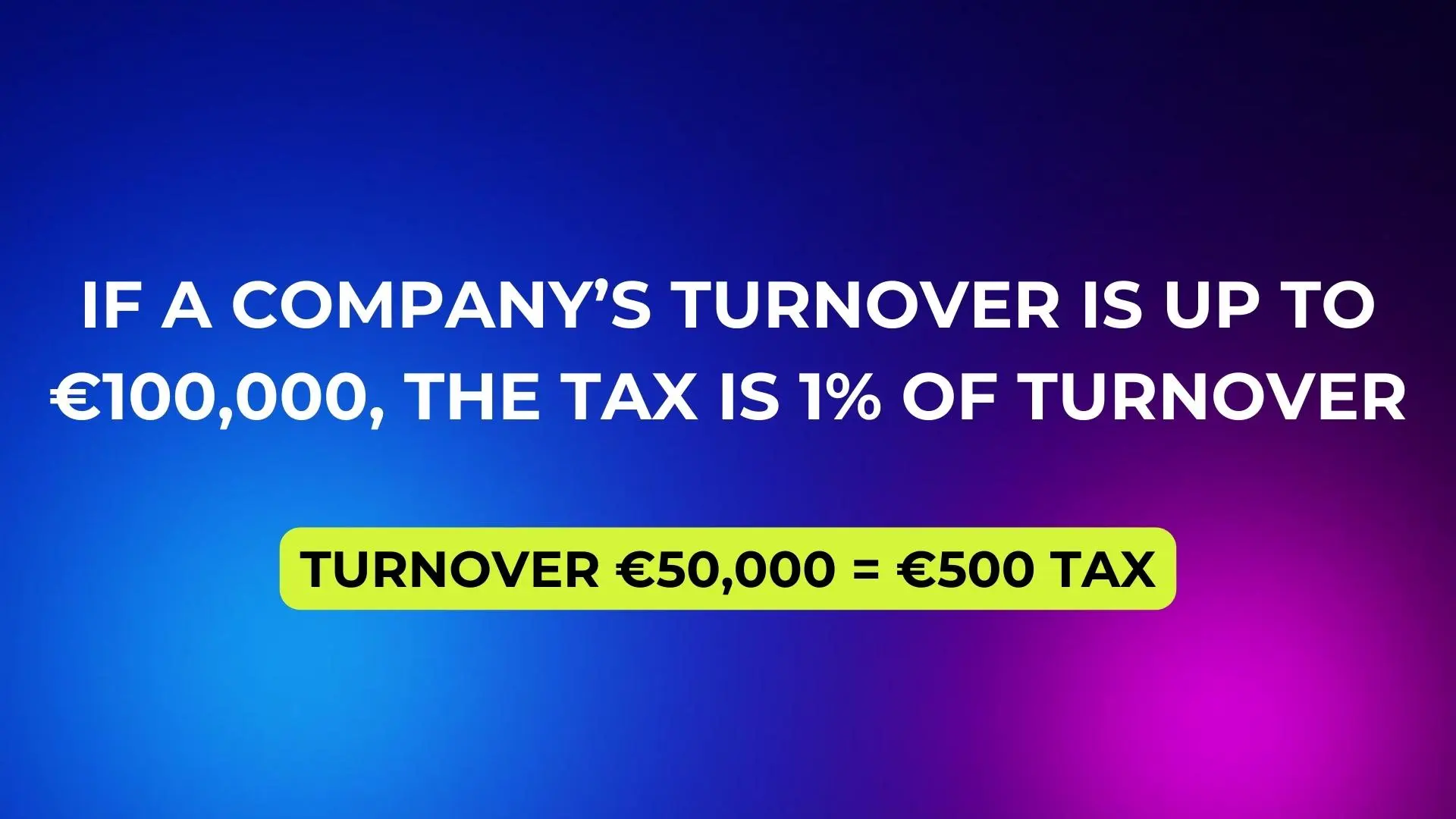
As of 1 January 2026, the activity-type restrictions for applying the simplified scheme (the micro-company regime) in Romania have been abolished. That is, the list of “prohibited” NACE codes no longer applies, and a company may use this regime regardless of the activities it chooses (provided it meets the other eligibility criteria, in particular the turnover threshold and the requirement to have an employee, one full-time employee working 8 hours per day).
If a Romanian micro-enterprise earns income exceeding EUR 100,000, it is required to pay CIT at 16% starting from the quarter in which the threshold was exceeded.
Recommended article
Microenterprise regime in Romania for IT companies: what are the benefits?
For IT businesses, Romania’s microenterprise regime often appears attractive because tax is calculated on turnover, rather than profit, and if eligibility criteria are met, the rate can be 1%. This is especially relevant for service-based IT companies and small SaaS projects, where the cost structure may fluctuate significantly and margin planning matters more than “paper” profit.
In practice, this brings several advantages for IT companies:
- Easier financial planning: it’s simpler to forecast taxes when they are tied to turnover rather than profit.
- Fits a service-based model (outsourcing, consulting, or agency services): where the main value comes from the team’s work, and expenses are often standard and recurring.
- Convenient for a small team: when the company is at an early stage or testing the market, and the owner wants predictable tax exposure without complex calculations.
- Works well for gradual scaling: start with lower turnover and predictable taxes, then move to another regime as the business grows.
Important!
The microenterprise regime has eligibility conditions (turnover cap, company structure requirements, and other criteria). Before launching an IT company, it’s worth confirming whether your business model qualifies and how it may affect dividends, VAT, and accounting compliance.
When does a company in Romania switch to the standard CIT regime?
The standard CIT regime in Romania operates under the classical European model and applies to all companies that are not subject to the micro-enterprise regime or that have lost the right to apply it.
The 16% corporate tax rate applies to:
- all Romanian companies (SRL, SA, etc.);
- permanent establishments of foreign companies in Romania;
- companies that have exceeded the micro-enterprise turnover threshold or no longer meet the conditions required to apply that regime.
Under the standard CIT regime, the company’s profit is charged, not its total turnover. The Romanian Tax Code clearly defines which expenses are fully deductible, which are partially deductible, and which are non-deductible for fiscal purposes.
The reporting period for Romanian CIT is the calendar year. Advance corporate income tax payments are made quarterly, and the annual return is filed after the financial year ends. Losses may be carried forward to future periods.
Calculation formula:
Profit = income – deductible expenses (± tax adjustments)
What is the minimum turnover tax (IMCA) in Romania, and when does it apply?
For large taxpayers, the following rule applies: if the calculated Corporate Income Tax is excessively low compared to the company’s turnover, IMCA (the minimum turnover tax) applies. This is an anti-avoidance mechanism for large companies and corporate groups and represents an alternative form of taxation within the standard CIT regime.
What Does This Mean in Practice?
Previously, a company paid 16% of its profit as corporate income tax. Under the IMCA rules, this payment continues to apply only if its amount exceeds 0,5% of turnover.
Otherwise, the company is required to pay 0,5% of turnover, even if its actual profit is minimal (rules updated as of 01.01.2026).
For companies with high turnover, the higher of the following two charges applies:
- 16% corporate income tax on profit; or
- 0,5% of turnover, if the 16% CIT amount is lower than this threshold.
IMCA applies exclusively to companies that:
- are subject to the standard CIT regime;
- have an annual turnover exceeding RON 50 million;
- calculate CIT (16%), which is lower than 0,5% of turnover.
This rule does not apply to micro-enterprises, sole traders (PFA), or other organizational forms that do not pay corporate income tax.
Example 1 – Minimum Tax Applies
The turnover of company SRL-1 is RON 60 million, and its taxable profit is RON 1 million.
– CIT: 1,000,000 × 16% = RON 160,000
– Minimum tax: 60,000,000 × 0,5% = RON 300,000
SRL-1 will pay RON 300,000, as this is the higher amount.
Example 2 – Corporate Income Tax Applies
Company SRL-2 has the same turnover of RON 60 million, but its taxable profit is RON 15 million.
– CIT: 1,000,000 × 16% = RON 160,000
– Minimum tax: 60,000,000 × 0,5% = RON 300,000
SRL-2 will pay CIT in the amount of RON 2,400,000.
In 2025, the business community actively advocated for the cancellation or modification of the IMCA while the 2026 budget was being drafted. Moreover, the Romanian government has planned to fully abolish the IMCA starting in 2027.
When is a business required to register for VAT in Romania?
VAT in Romania is a classic European VAT, fully harmonized with EU directives. VAT is levied at each stage of the supply chain, while the final tax burden is borne by the end consumer.
The standard VAT rate in Romania is 21%. At the same time, a reduced VAT rate of 11% applies to certain categories of goods and services.
Mandatory VAT registration arises once turnover reaches RON 300,000 from the beginning of the financial year, which is the VAT registration threshold in Romania. Registration is carried out with ANAF (the Romanian tax authority). Companies that exceed the VAT registration threshold are required to charge VAT on advance payments received before the VAT registration date, provided that the supply of goods or the provision of services takes place after the VAT registration date.
Recommended article
Voluntary VAT registration is possible even if the statutory threshold has not been reached, in particular where the business works with VAT-registered counterparties, incurs significant input VAT expenses, or carries out exports or intra-Community trade.
Output VAT is charged on sales, while input VAT is paid to suppliers. The amount payable to the state budget is the difference between output VAT and input VAT. If input VAT exceeds output VAT, a negative VAT balance arises, which may be carried forward to future reporting periods or claimed for refund. More details on VAT operates in the EU.
VAT returns are filed monthly, and for this purpose, companies must retain all incoming and outgoing invoices, including the VAT numbers of counterparties.
Dividend Tax in Romania
Dividend tax in Romania is a separate form of taxation on capital income and is of fundamental importance to business owners, as it is payable after corporate taxation.
In Romania, the dividend tax rate was 10% in 2025, and as of 01.01.2026, the government has increased it to 16%. This rate applies to both individuals and legal entities in respect of income received from 1 January 2026.
If the dividend recipient is a tax resident of any country, the Double Tax Treaty between the country and Romania may provide relief from double taxation, subject to applicable conditions, which is particularly relevant for Romanian taxes for entrepreneurs For example, in Ukraine, under this intergovernmental agreement, the rate on dividends may be reduced to 15%.
Recommended article
To apply the reduced rate, the company owner must provide the Romanian company with a certificate of Ukrainian tax residency. In Ukraine, the received dividends must be declared in the annual income statement, with the mandatory payment of the military levy. declared in the annual income statement
Tax changes in Romania from 2026
Legislative changes took effect as of 01.01.2026. New companies must have a share capital of at least RON 500 (approx. EUR 100) at the time of registration.
In addition, all legal entities are required to maintain a bank account with a Romanian bank or the State Treasury throughout their entire period of operation. The absence of such an account may result in the company being classified as tax inactive by ANAF, and in certain cases may even lead to liquidation in accordance with applicable legislation.
In 2026, Romania’s tax system remains one of the most transparent and predictable in Eastern Europe. At the same time, businesses should carefully consider the key changes and plan their financial activities and capital structure taking into account not only taxation rates, but also double tax treaty mechanisms and VAT optimization opportunities. In 2026, Romania continues to maintain a competitive tax model for small and medium-sized enterprises, and the micro-enterprise regime may be an effective solution for IT businesses and agencies for which simplicity of taxation is a key factor.
Key takeaways
- the micro-company regime is beneficial, but it comes with strict turnover limits;
- the 16% CIT rate applies after the loss of the right to the micro-enterprise regime (exceeding statutory thresholds);
- the minimum turnover tax (IMCA) affects large companies with high turnover;
- tax planning is critical to avoid excessive fiscal burden.
This is especially relevant when navigating taxes in Romania for businesses with different turnover levels and operational models. We continue to monitor changes in European tax regulations in general and in Romania in particular. To make the most effective use of the Romanian tax environment and minimize risks contact a WoBorders tax expert WoBorders. We will help you understand Romania, choose the optimal business structure, and support you at every stage, from planning to full taxation compliance.


