

Contents
Modern digital marketing has long ceased to be merely a set of tools such as banners or social media posts. Today, it represents a full-fledged operational system of a business. It is responsible not only for lead generation flows, but also for brand positioning, market trust, team alignment, and internal processes. According to Forbes, it is precisely this level of integration that has become one of the key factors driving company scaling throughout the 2020s.
That is why the choice of a marketing format for a business, whether a marketing agency, a freelancer, a part-time CMO, or an in-house department, becomes a strategic decision rather than merely a matter of selecting a contractor.
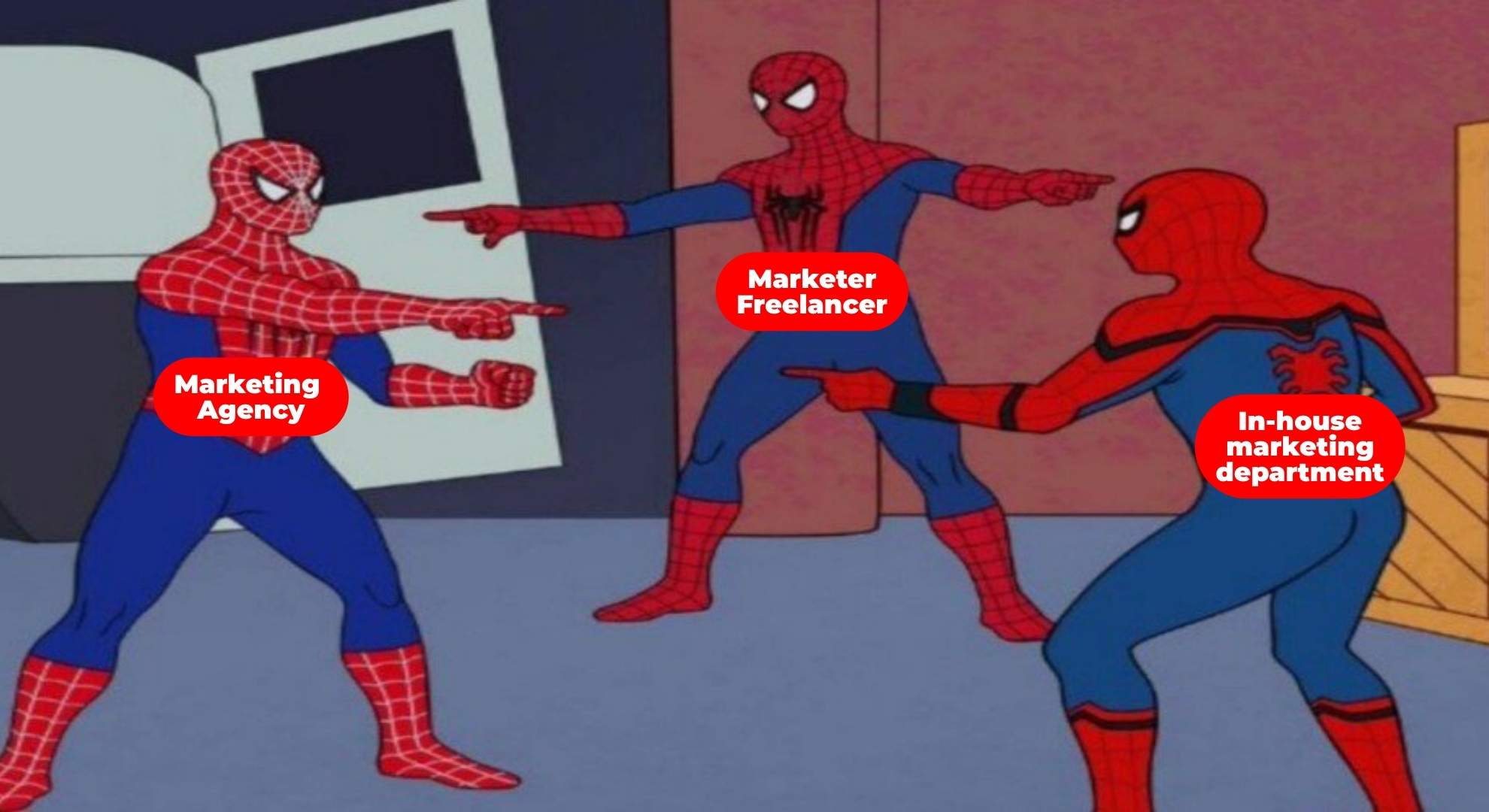
In this reality, the key question is framed differently. Not “where to find a marketer,” but if the marketing format, an agency, freelancer, part-time CMO, or in-house team, truly aligns with your business in 2026.
Before choosing tools or searching for a specific specialist, it is worth viewing the situation without illusions, through the prism of objectives and resources. Experience shows that a strategy not supported by resources is destined to remain just a presentation. And resources without a clear strategy quickly turn into expenditures without results.
Business Goals for 2026: Where Are You Actually Heading?
It is worth starting not with the choice of a contractor, but with an understanding of the business’s trajectory. The year 2026 is no longer about chaotic experimentation, but about deliberate, informed decisions.
The first thing that needs to be determined is whether you are still at the stage of searching Product–Market Fit, or whether you already have validated growth channels and are ready to scale them through systematic investments in marketing. These are fundamentally different scenarios that require different approaches, teams, and budgets.

Next, the growth vectors. What is a priority for you: a stable flow of qualified leads, strengthening the brand and recognition, entering new markets (US, EU, LATAM), or launching a new product or business line? A single marketing function cannot effectively “carry” all these goals simultaneously without clear priorities.
Once the goals have become clear, it is logical to move on to a less romantic but critically important part—resources.
Let’s start with the budget. What is the real monthly limit you are prepared to allocate to marketing, including advertising expenses and the payment for specialists’ work? This very figure immediately rules out unsuitable collaboration formats.
The second factor is managerial resources. Is there someone within the company capable of assuming the role of marketing owner: the business owner, CEO, or CMO who is ready to make decisions, set tasks, and take responsibility for the results?
And third, time for processes. Are you ready to invest your time in building analytics, automating funnels, aligning KPIs, and documenting processes? Without this, even a strong team will operate fragmentarily.
And finally, what resources are you ready to invest? Think of it as your fuel reserve
Marketing does not scale on enthusiasm. It scales on money, management, and time.
Our practical insight: clearly formulated answers to these questions reduce the time needed to find the appropriate marketing format or specialist by at least half, and eliminate the majority of erroneous decisions from the outset.
Format #1: Marketing Agency for business – An external team for scaling
A marketing agency is an external team engaged to partially or fully handle marketing tasks “turnkey.” Most often, this format is chosen by growing eCommerce projects, B2C businesses, and tech startups that value fast, systematic, and scalable results without delving into internal HR and operational management. This is precisely why companies often choose this format when considering an agency versus in-house marketing in the context of rapid growth.
Advantages of an Agency: speed and depth
- Instead of a single person, you get a team: Project Manager, media buyer, designer, copywriter, analyst, and so on. This is a flexible system that can be quickly adapted to new tasks, channels, or markets without additional hiring.
- Агенції працюють з десятками проєктів, бачать типові помилки й знають, що реально працює. Вони приносять із собою best practices і перевірені підходи – зокрема для виходу на нові ринки (EU, U.S., and other jurisdictions).
- There is no need for months of recruiting and onboarding. With clear goals in place, marketing campaigns can start within 2–3 weeks.

Disadvantages of an Agency: cost and control
- The entry threshold is higher , as quality expertise comes at a price. A budget is required both for the agency’s services and for the advertising spend itself. For small businesses, this can be a limiting factor.
- If a project is not a priority for the agency, there is a risk of superficial work. This is why, when choosing a partner, it is important to look not only at case studies but also at the working model and the number of active clients.

- There is less direct control - as operational management of marketing lies with the agency rather than within the company. For some owners, this is a disadvantage; for others, it is a way to relieve themselves of operational burden.
Who is this format suitable for? Companies that want to focus on the product and the business rather than managing a marketing team. Also, for those planning growth or entry into new, less familiar markets.
Recommended article
Format #2: Freelance for Marketing – A specialist for a specific task
A freelancer is a single specialist who covers a specific area: PPC, SEO, SMM, design, or content. This format is often used for testing hypotheses or quickly addressing a “bottleneck” in the sales funnel.
Advantages of a Freelance: flexibility and budget
- Low entry threshold: you can start with minimal expenses and test a single channel without long-term commitments.
- Direct communication without unnecessary bureaucracy: approvals and revisions happen quickly.
- Ease of changing focus when one direction does not work: you can quickly adjust the approach or switch the specialist.
Disadvantages of a Freelancer: limitations and risks
- The “one-person” resource: a single individual is rarely able to be simultaneously a strong strategist, executor, and analyst. Constant multitasking inevitably affects quality.
- Stability risks: illness, burnout, or changes in the freelancer’s priorities directly impact the stability of your marketing activities.
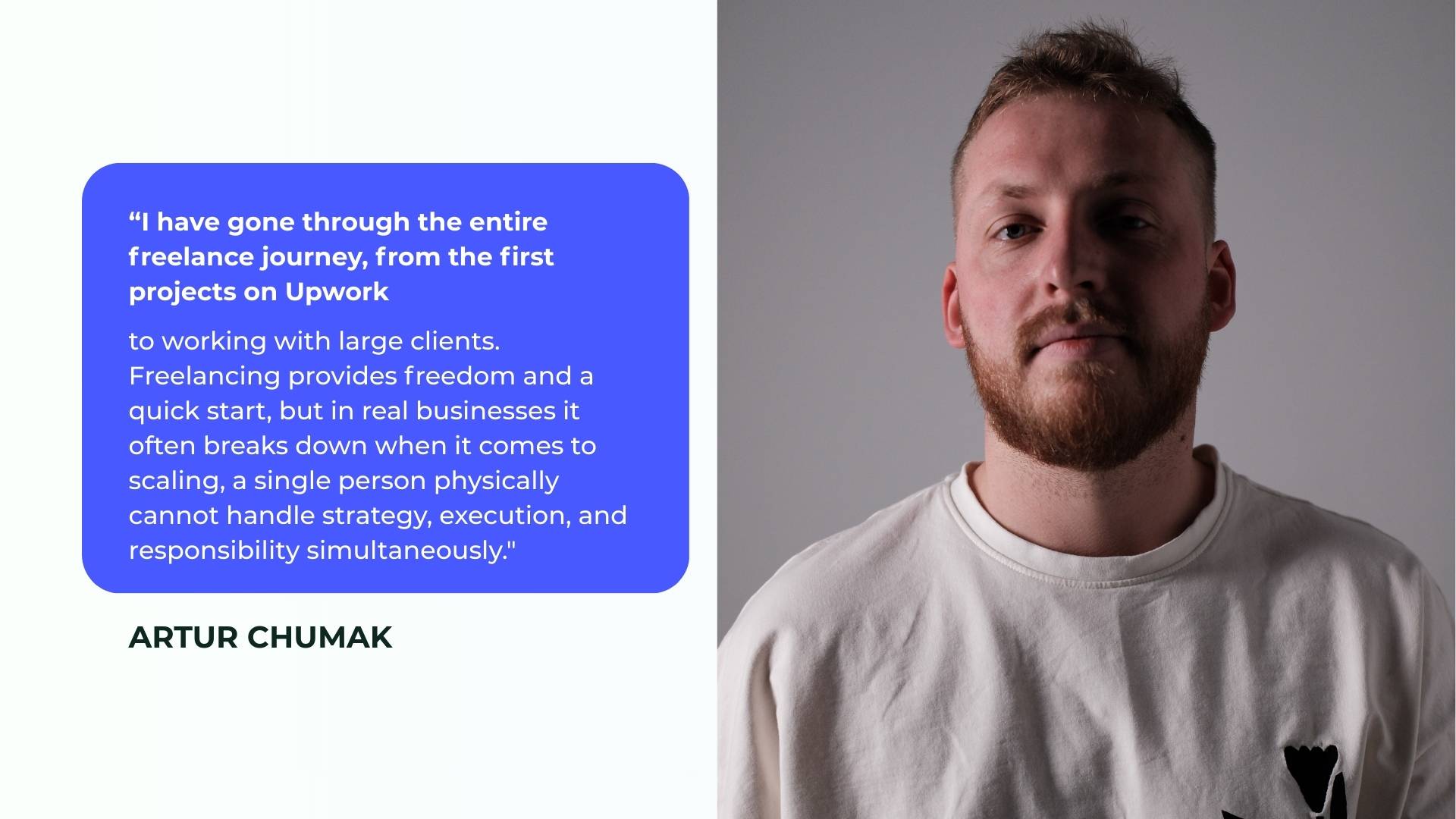
- Need for Management: a freelancer requires clear briefs, deadlines, and oversight. Without these, they quickly turn into an “always busy person without measurable results.”
This is precisely why the question “freelancer or agency” becomes critical at the stage of business scaling.
Who is this payment system for? Small businesses at the start, which are only beginning to experiment with systematic marketing. Or companies where the founder has the time and willingness to actively manage the process.
Format #3: Part-time CMO / Virtual CMO – An External CMO for the Business
A part-time marketer or Virtual CMO is usually a specialist at the CMO or Head of Marketing level who engages with the business for several hours or days per week. Their key value lies not in “doing hands-on work,” but in organizing marketing into a system: defining objectives, building funnels, selecting channels, setting up analytics, and establishing the rules of the game for the executors.
This format often becomes the optimal compromise for businesses that have outgrown chaotic freelancing but are not yet ready, or it does not make sense, to retain a full-time CMO. You gain a strong strategic “head” without overpaying for a full-time format, but you must clearly understand the limitations: a part-time marketer has limited time and no “hands-on” capacity. Advertising launches, design, content, or technical setups will still be carried out by separate contractors, an agency or freelancers.

This is why this format works best in combination: the Virtual CMO sets the direction, keeps the focus on results, and controls quality, while the executors simply implement the strategy. At the same time, for micro-businesses with minimal budgets, this approach may be premature, when every dollar must go directly into traffic, strategy without execution quickly loses its value.
Our practical experience shows that even a few strategic sessions with a specialist of this level often resolve 80% of questions, help assemble the team correctly, and avoid costly mistakes even before scaling.
Format #4: In-House Marketing – The Company’s Own Marketing Department
In-house marketing represents the highest level of engagement. You build an internal team, integrate it into all company processes, and gradually develop marketing as part of the business core. This is where the maximum depth of understanding of the product, services, clients, and internal constraints emerges.
In complex B2B, consulting, and service models, such depth often becomes a competitive advantage. With proper setup, an in-house team can achieve the best long-term balance between results and costs, as well as ensure close alignment between marketing, sales, and product. However, having an internal department is always a long-term game. It requires not only belief in the results but also significant resources. The entry threshold here is the highest of all formats: salaries for multiple specialists, HR processes, onboarding, training, and management. Fully building a team can easily take six months.
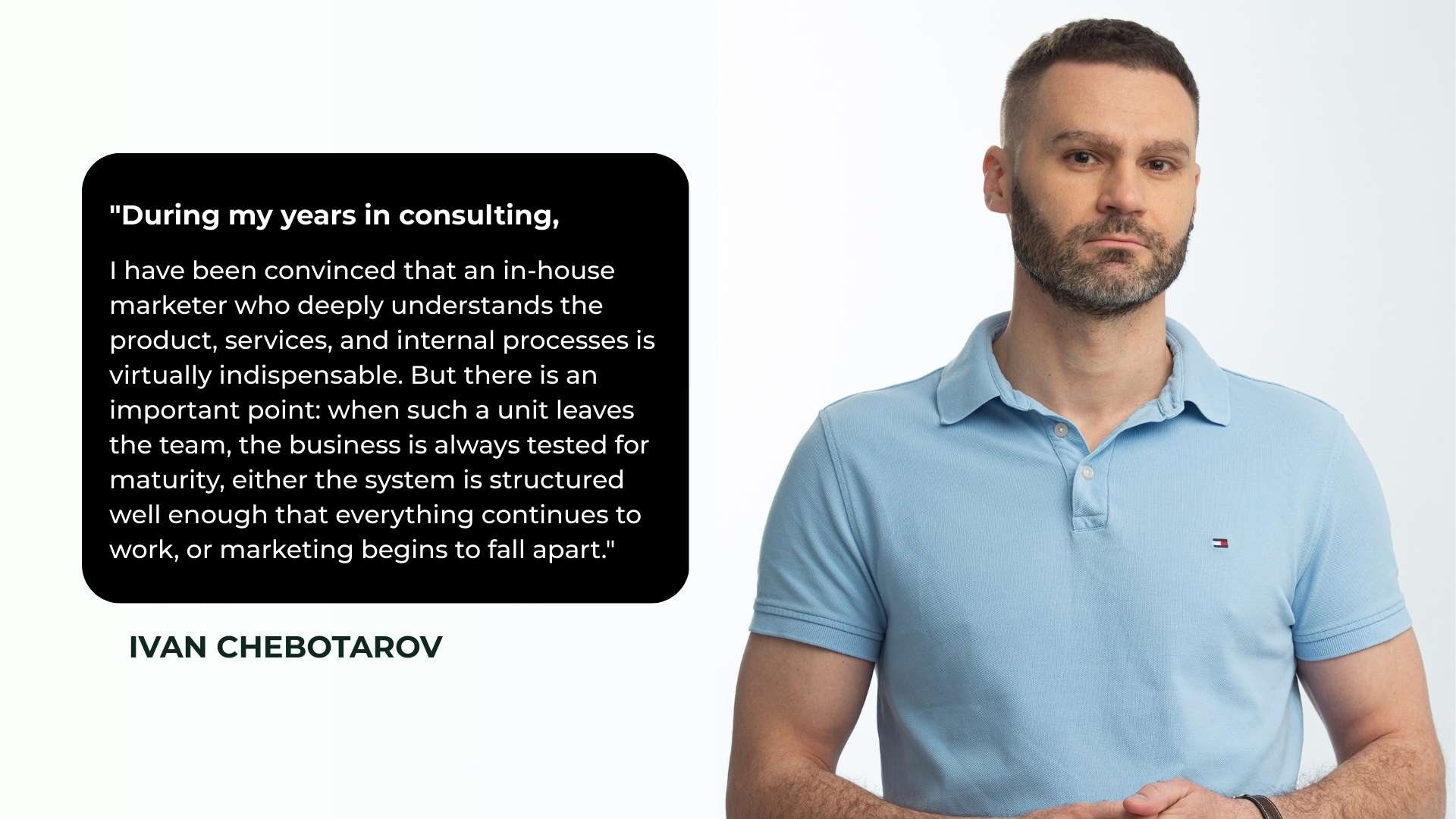
This is why the in-house format is not only about control, but also about responsibility. Hiring, onboarding, motivation, retaining key personnel, and building processes that function independently of specific individuals require time, experience, and managerial resources.
This format is suitable for mature businesses with a stable budget and a clear understanding that marketing is not a short-term campaign, but an asset that requires systematic investment.
One of the key risks is the “marketing swamp.”. Without a strong management layer (CMO or Head of Marketing), even a talented team can turn into a group of perpetually busy people: lots of activities, reports, and motion, but minimal impact on business results. This is one of the most common mistakes when building in-house marketing.

There is also a less obvious, but no less important nuance, limited external experience. A team that has worked for years on a single product gradually loses touch with fresh market insights. This is precisely why even large companies with strong in-house departments regularly engage agencies or external consultants, not for execution, but for a fresh perspective.
Who is the In-House format suitable for? Companies with stable turnover that clearly understand that marketing is a continuous, critical function, not a temporary campaign. This is especially relevant for businesses with high internal specificity: legal, consulting, complex B2B, and technical products.
Comparison of marketing formats for companies: agency, freelance, part-time CMO, and in-house team
| Criteria | Agency | Freelancer | Part-time CMO | In-house Team |
|---|---|---|---|---|
| Cost | High | Low | Medium | Very high |
| Speed | Very fast (2–3 weeks) |
Fast (≈1 week) |
Medium | Slow (3+ months) |
| Expertise | Comprehensive (team of specialists) |
Narrow (single specialization) |
Strategic and managerial | Deep product knowledge |
| Management Time Required | Low (managed by PM) |
High (briefing and supervision) |
Medium (managing contractors) |
Very high (HR + management) |
| Flexibility | Very high (easy team scaling) |
High (easy focus changes) |
Medium | Low (hard to hire/fire quickly) |
A Choice that determines the trajectory
The marketing format is not about “who to hire.” It is about how exactly your business will grow: in leaps or systematically, intuitively or predictably, locally or without geographical limits.
In 2026, the winners will not be those who carry out more activities, but those who build a working growth model. And there is no universal solution here: for some, a strong part-time strategist is sufficient; for others, an external team that can quickly take over all marketing is the right choice; and for some, establishing their own in-house department becomes the logical step. The key is not to make a mistake with timing and format.
If you are already thinking about new markets, complex funnels, scaling sales, and a clear forecast of results, sooner or later the question becomes not “do you need marketing,” but who and in which model is capable of handling it.
At WoBorders, we work precisely with these situations. We do not sell “marketing services”, we help businesses choose the marketing format for scaling and entering international markets.
Want to find out which format suits you best? We start with a brief conversation—no obligations and no “hard sell on the first call.” We will help analyze your situation, show the options, and suggest the optimal next step. Schedule a strategic consultation and understand where your business should start.