

Contents
When we at WoBorders began to explore payment services for clients more deeply, one thing became clear: modern solutions are no longer just about "accepting payments." They are a rich source of customer data, revealing purchasing habits, preferences, behavior, and the points where sales are lost.
We have long been working with international payment systems for businesses selling in the EU, the United States, and other markets. However, to have a complete picture within the Ukrainian context, it is equally important to look separately at the capabilities of local Ukrainian payment solutions, and how they can strengthen both sales performance and customer service.

Together with our partners at hutko we decided to share practical experience on how payment analytics, across both international and Ukrainian systems supports growth: increasing conversion rates, improving the customer journey, and enabling more accurate, data-driven business decisions.
Recommended article
Why a payment system is more than just payment processing
Traditionally, businesses view a payment system as a purely technical tool: a customer clicks "Pay" the funds are credited to the account, and that’s the end of it. In reality, however, every transaction is a micro-story about your customer.
What payment data reveals
When we integrate WooCommerce or Shopify with a payment service for our clients, we immediately gain access to a comprehensive set of insights:
- Time of purchase — when your audience is most active
- Average order value — how much different customer segments are willing to spend
- Payment conversion rate — at which stage customers drop off
- Customer geography — where your revenue comes from
- Payment methods — how your customers prefer to pay
- Repeat purchase frequency — who your loyal customers are
- Rejections and reasons for failed payments — what prevents you from earning more
It is particularly important that the Ukrainian payment system hutko provides detailed analytics for each of these parameters within a user-friendly merchant portal interface. Integration with WooCommerce is handled via a ready-made plugin that can be installed in just 10 minutes, while for Shopify hutko is the only Ukrainian payment system with an official integration. This saves a significant amount of time that was previously spent consolidating data from multiple sources. This saves a significant amount of time that was previously spent consolidating data from multiple sources.
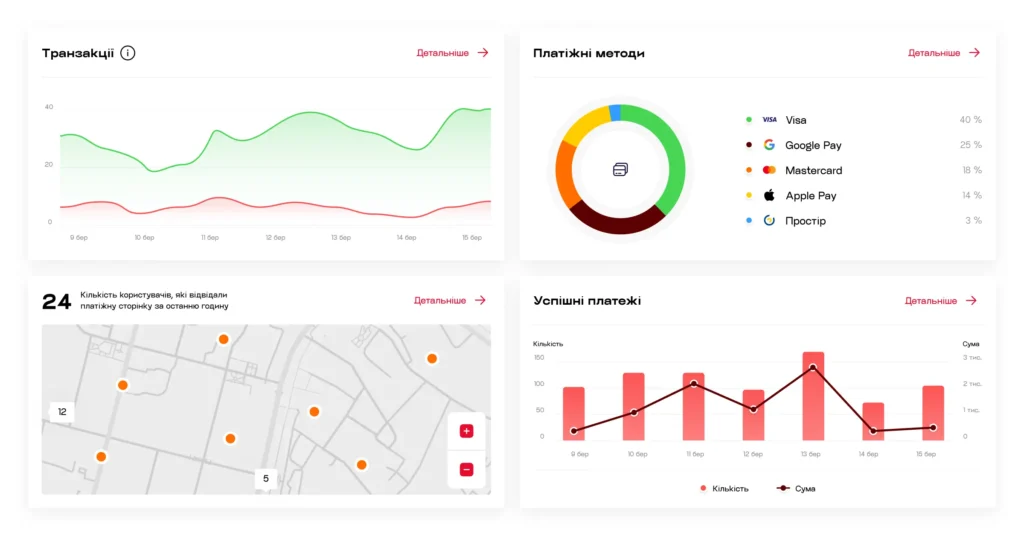
hutko Analytics Dashboard
How to interpret payment data: A practical guide
Scenario 1: Analyzing purchase timing
hutko analytics may show that most successful payments occur during specific hours. This is simple information, but how should it be used?
– Launch targeted email campaigns during peak hours
– Schedule new product releases for periods of highest activity
– Strengthen live chat support precisely when customers are ready to pay
Scenario 2: Geographic analytics
Payment systems for websites integrated with Shopify do more than simply show a customer’s country—they make it possible to see where the highest revenue is coming from. It often turns out that while large cities generate more orders, customers from regional areas may have a significantly higher average order value. This can fundamentally change an advertising strategy by allowing budgets to be reallocated toward more promising regions.
Scenario 3: Payment method analysis
With hutko’s WooCommerce integration, businesses gain clear visibility into how customers prefer to pay. Shoppers using Apple Pay or Google Pay often return more frequently. The reason is simple: these are convenience-driven, tech-savvy users. By segmenting them in your email marketing and emphasizing speed and ease of service, you can build stronger loyalty and repeat sales.
Payment conversion: The key metric everyone overlooks
This is where things get truly interesting. Many businesses focus on overall website conversion rates but overlook payment conversion, the percentage of successful payments out of the total number of payment attempts.
Why this Is critically important
Imagine this scenario: 100 people add a product to their cart and click "Pay." But only 65 complete the payment successfully. Where did the other 35 customers go? And more importantly, where did 35% of your revenue disappear?
How to improve payment conversion
Based on payment system analytics, we have identified several key optimization points:
- Payment page loading speed. Every additional second of page load time reduces conversion rates by 7%.
- Number of available payment methods. Data shows that if a customer does not see their preferred payment method on the checkout page, 40% will simply close the tab.
- Process transparency. Customers need to clearly understand what is happening. Unexpected fees, unclear steps, or the absence of a progress indicator all significantly reduce conversion rates.
Customer segmentation through the lens of payments
One of the most powerful capabilities provided by payment system analytics is the ability to build precise customer segments.
Behavior-based segmentation
Using payment data, it is possible to identify distinct groups of customers:
Impulse buyers
- Make purchases quickly, often in a single click
- Higher average order value
- Most active in the evening hours
- Rarely use promo codes
Strategy: Time-limited personalized offers with a focus on new arrivals.
Rational buyers
- Take time to choose and compare options
- Actively look for discounts
- High return rate at the catalog browsing stage
- Prefer proven, traditional payment methods
Strategy: Detailed product descriptions, customer reviews, comparison tables, and loyalty programs.
VIP customers
- High average order value
- Regular, repeat purchases
- Use fast payment methods
- Low decline and abandonment rates
Strategy: : Early access to new products, personalized service, and exclusive terms.
Forecasting through payment data
Payment system analytics is not only about the past—it is also about the future.
What can be forecast
- Demand seasonality. Historical payment data reveals precise peaks and declines in activity. This makes it possible to plan procurement, marketing campaigns, and logistics more effectively.
- Customer lifetime value (LTV). Purchase frequency + average order value + trend = a forecast of how much revenue a customer will generate over the course of a year.
- Churn risk. If the interval between a customer’s purchases increases by 30% or more, they enter a risk group. This is the moment to activate retention mechanisms.
- Growth potential. Which products are frequently purchased together? Which categories have the highest repeat rate? Payment data provides clear answers to these questions.
Tools for working with payment analytics
In addition to the built-in analytics available in the hutko merchant portal, businesses can leverage a broader ecosystem of complementary tools.
Basic Level
- Google Analytics 4 — tracking the user journey leading up to payment
- Hotjar / Microsoft Clarity — heatmaps and session recordings on the checkout page
- Built-in CMS analytics — WooCommerce Analytics or Shopify Reports
Advanced Level
- Power BI / Google Data Studio — custom dashboards combining data from multiple sources
- SQL queries to databases — deep analysis of complex behavioral patterns
- Python scripts — automation of routine reporting tasks
Conclusion
Payment analytics is the shortest path from “it seems customers are dropping off at checkout” to a precise understanding of, where why, and how much revenue a business is losing every day. It reveals real customer behavior: when customers pay, which payment methods they choose, at which step they stop, which segments generate the most profit, and what prevents repeat purchases.
In practice, this means one thing: instead of optimizing the “website as a whole,” you start improving specific bottlenecks in the payment funnel—and achieve higher conversion rates and revenue growth without endlessly increasing your advertising budget.
To extract maximum value from your data, it is enough to follow a simple cycle:
- Set up correct integration (to see a complete picture of successful and failed payments, payment methods, geography, timing, and repeat purchases).
- Select 1–2 impact metrics (primarily payment conversion rate and abandonment rate) and establish a clear baseline "as is."
- Identify one insight → implement one change (payment methods, checkout speed and logic, fee transparency, peak-hour support, communication segmentation).
- Measure the impact and scale what delivers results.
If you operate in the Ukrainian market, there is an additional advantage: local solutions such as hutko provide clear, detailed analytics in the merchant portal and fast integrations with popular CMS platforms. As a result, the path from “data” to "decisions" becomes significantly shorter.
A payment system should no longer be just a "money conduit." It is a tool that delivers daily guidance on how to earn more—more precisely, faster, and with fewer losses at every step of the payment process.
Our role is to remove operational complexity and create a clear, predictable working environment so entrepreneurs can focus on development, team building, and growth. We operate Monday to Friday from 9:00 AM to 7:00 PM. If you need contact us here at a convenient time.


