

Contents
Advertising here, advertising there. It can feel like everyone is “generating leads” these days; your cousin, your brother, your IT-savvy neighbor, even your mother-in-law seems to be “scaling a business.” Sounds familiar?
And yes, there’s some truth to it. Scaling a business through paid traffic does work and is often the fastest way to reach customers abroad. But the real question isn’t whether the channel works, it’s how you use it when entering a new market, registering a company in Estonia, Cyprus, or the US and planning growth in another country.
Recommended article
Because there’s a huge gap between “we just launched ads in Poland” and “we built a Google marketing system to scale our business in a new market.”
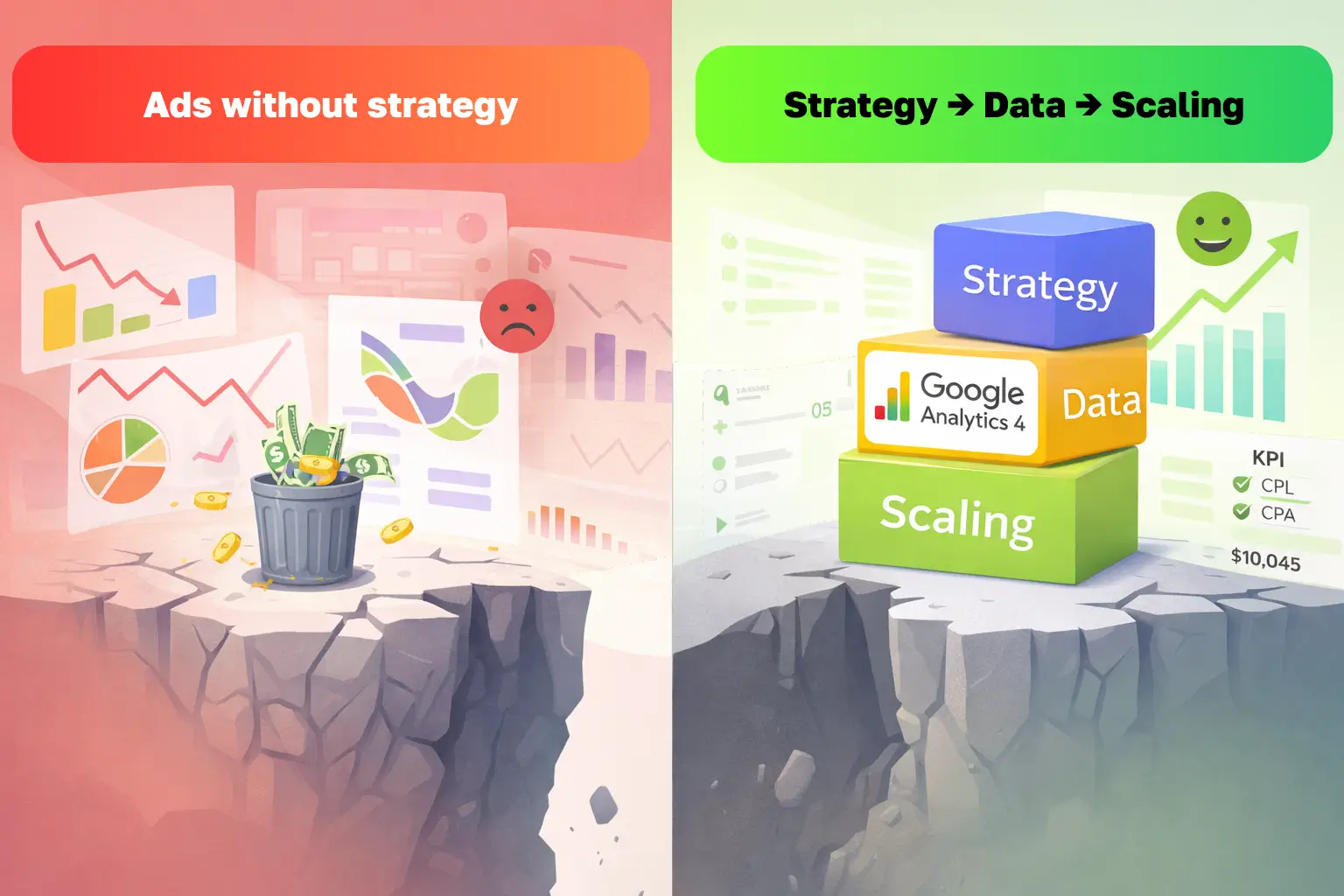
The first approach usually burns through the budget. The second one builds a business. In this article, we’ll show the logic behind a system-based approach, without unnecessary theory. How to make international promotion look “like everyone else’s,” but deliver better, controlled, and predictable results. To understand this, we first need to separate two things that are often confused: marketing and advertising.
Marketing as a strategy, not a toolkit
At the early stage of a business, this isn’t always obvious. But once a company enters the growth phase, the question is no longer “which channel should we turn on.” It becomes much deeper: how to make data-driven decisions, how to tell what truly works from what is simply “running,” and how to avoid a situation where there are leads but no clarity.
This is the moment when a platform stops being just an expense and starts working as business infrastructure for scaling through Google Ads. It either strengthens the business or chaotically drains the budget, depending on whether there is a system behind the advertising.
This is especially clear during the scaling stage. When a business tries to enter 10 countries at once with raw campaigns, it may look like rapid growth from the outside. In reality, it’s not sales that scale, but the mistakes of advertising campaigns built without a systemic marketing strategy.
You don’t scale a business. You scale what already works. If a structure doesn’t deliver consistent results in one country, replicating it across markets only multiplies the problems.
That’s why a systematic approach to scaling looks different:
– start with 1–2 countries as a pilot;
– choose markets with the strongest potential;
– bring the model to stable performance;
– learn not just to generate leads, but to turn them into customers;
– and only then scale the proven structure into other markets.
This is what scaling through digital marketing really looks like, without chaotic budget experiments or trying to force results by throwing money at Google.
But even before advertising and scaling, there is a step many businesses skip. Before reaching for the “add budget” button in Google Ads, it is worth pausing and looking at the market before launching in a new country. It is very similar to company registration: first comes market analysis, then action. The same logic applies in marketing.
To understand how to enter a new country with minimal risk, you do not need 80-page reports. In most cases, a short but structured analysis using Google tools is more than enough.
Discovery stage: what we analyse before launching ads
| Tool | What We Check (Simple Explanation) | How Is It Used? |
|---|---|---|
| Search | We search queries like company registration Estonia, taxes Cyprus 2026 and analyze who ranks at the top: law firms, aggregators, or real competitors | Helps understand the competitive landscape and the actual search terms people use. This becomes the foundation for strategy and keyword research |
| Google Trends | Whether interest in your service has been growing in a specific country over the last 12–24 months | Helps distinguish between an active market and one that is declining or stagnating |
| YouTube | Whether there are videos on your topic, their quality, and how many views they receive | If there is little or outdated content, this creates an opportunity to quickly build trust and warm up the audience |
| Google Business Profile (GBP) | How many reviews competitors have, their ratings, and how their businesses appear in search results | Acts as a “trust detector.” If competitors have many reviews, it is a signal that you also need to build strong social proof |
Singapore is not just a place to incorporate a legal entity. It is an environment where businesses connect with capital, talent, and regional markets. In 2025, the country ranked among the world’s leading startup ecosystems, confirming its evolution from a regional hub to an international center for management, finance, and innovation.
This level of surface-level but structured analysis is usually enough to understand where to start and which country actually makes sense to enter, even before launching Google Ads.
But then comes the next question: what exactly are we launching, and what role does Google actually play in this process? Advertising is only the tip of the iceberg. Beneath it sits a much larger system that either strengthens the business or quietly drains the budget.
That is why this ecosystem should be viewed not as an advertising channel, but as a full business infrastructure.
The Google Ecosystem: four levels of the business system
Google is more than advertising. It is an ecosystem that either helps a business grow or quietly drains its budget. When viewed systemically, Google can be understood as an international business center with four levels. Each level has its own role, and problems begin when even one of them is missing.
For service-based businesses and companies entering international markets, this ecosystem is critical. It determines not the number of clicks, but the controllability of growth.

Level One: Presence and Trust (Face Control)
The first level defines one essential thing: how Google and users perceive your business, as a reliable partner or as a “risky ad page.”
The system does not read your documents and does not know that you are a legitimate business. It reacts to signals: behavioral, technical, and content-related.
That is why a formally legal business can still get blocked if it looks “suspicious” to the system:
– no Google Business Profile or an empty one;
– a new website with no history or expert content;
– ads in one language, forms in another, communication in a third;
– no clear contact details, legal pages, or local signals.
The outcome is predictable: the account is paused, ads stop running, and stress levels rise.
The logic is simple. Before Google starts bringing you customers, it needs to trust that you are a real business. That is why, at the start of scaling, it is more important to address basic trust signals than to “push Ads harder.”
One of the key tools at this level is Google Business Profile (GBP). It is your business card in search and on Maps: reviews, rating, phone number, and website. In new markets, this is often the first point of trust, even before a user clicks on an ad.
Real-life case (a typical “why were we blocked if we’re fully legal?” scenario)
We launch a new direction. The business is real and the documents are in order. Yet the account is paused almost immediately. The reason turns out not to be “policy violations,” but the fact that, for the algorithms, the business looks like a temporary ad page: a new domain, minimal content, no GBP, weak contact and legal pages, and different languages used in the ad and on the landing page.
The ending is positive once trust signals are fixed. But while the team was “proving we’re not a scam,” both budget and nerves were already burned.
At the same time, trust in Google is not built through GBP alone. It is reinforced by content that users see before or alongside advertising. When someone has already watched your video taxes in Cyprus or read your article on company registration in Estonia, they perceive your brand differently. You are no longer “just another ad,” but a familiar expert. That is why SEO and YouTube do not exist separately from advertising. They work as a trust foundation. Advertising brings traffic faster, while content explains why you are worth trusting.
However, even if trust is in place, it does not mean the business is ready to scale. The next critical question is whether you actually understand what happens to traffic and leads after the click.
Level Two: analytics and data as the operations brain
At this level, it becomes clear whether a business is scaling or simply spending its budget actively. Scaling without analytics is a lottery, and in new markets, you are almost moving blindly.
Analytics is not about “looking at charts.” It is about sending Google the right signals so it can optimize advertising properly. The key tool here is GA4 (Google Analytics 4) for ad scaling, together with correctly configured conversions: leads, messenger clicks, and phone calls.
Without this, the system optimizes for formal metrics like clicks and CTR. This is where budget leakage begins, often disguised as “our ads are working.”
Put simply, Google Ads is the driver, and GA4 is the navigation system and dashboard. Without GA4, the driver may be moving fast but has no idea where the destination is.
What must be set up (minimum for an international launch)
| Event / Conversion | What Do We Track? | Why Is It Important? |
|---|---|---|
| submit_form | Website form submission | Core conversion used to evaluate demand and optimize campaigns |
| click_phone | Click on a phone number | Tracks warm leads, especially important for service-based businesses |
| click_email | Click on an email address | Helps track inquiries outside standard website forms |
| click_messenger | Clicks to Telegram / WhatsApp / Viber | Shows real contact intent rather than just traffic volume |
| booking | Click on “Book a call” / Calendly | Tracks high-intent actions showing readiness for consultation |
| purchase / qualified_lead | Payment or qualified lead (via CRM) | Allows ad optimization based on revenue and quality leads instead of generic inquiries |
Required: UTM parameters must be fixed and linked to the source/campaign.
As scaling begins, lead quality becomes the key issue. Google can see a “form submission,” but it does not know whether that lead became a real client. That is why a GA4 + CRM integration and offline conversions in Google Ads are critical for revenue-based optimization. You are not sending Google a “lead”, but a business fact: this lead converted into a client and generated revenue.
Case: “Leads exist, but optimization does not work”
A classic scenario. Traffic is coming in, forms are being submitted, and leads exist. However, CPL increases, lead quality drops, and sales teams complain about “irrelevant” inquiries. The reason is usually simple: Google sees the form submission but has no visibility into what happens after. In international scaling, the critical setup is GA4 + CRM + offline conversions.
This directly changes the optimization logic:
– send clicks → optimization for clicks
– end leads without CRM → optimization for any leads
– send CRM data → optimization for revenue
Technically, this entire analytics and ad scaling logic is built on GTM (Google Tag Manager). GTM allows tracking all key user actions without constant changes to the website code. Form submissions, button clicks, messenger interactions, phone calls, and other key actions are captured via GTM and passed into GA4 and Google Ads as conversions.
For scaling, GTM is critical because it allows fast adaptation of analytics for new countries and languages. You can add events, adjust triggers, and test new scenarios without the risk of breaking the website. As a result, analytics stops being chaotic and becomes a managed part of the business infrastructure rather than a technical pain point.
At this point, Google stops operating blindly. The system starts to understand what a high-quality outcome looks like for your business and can scale revenue instead of just traffic.
Only after this is it advisable to activate the next system level.
Third level: paid traffic as the system
Paid traffic (PPC) starts working properly only when the first two levels are already in place: trust and analytics. At this point, paid search becomes an engine that accelerates an existing system rather than trying to pull the entire business on its own.
One of the most common mistakes when launching in new countries is putting everything into one campaign: countries, languages, keywords, funnel stages, and so on. The result is almost always the same: high CPL, messy data, and a budget that “disappears somewhere.”
In international PPC, a simple rule applies:
1 campaign = 1 country + 1 language. Not “Europe / EN” in one campaign, but a clear structure such as:
– Search | Estonia | EN | Company registration
– Search | Estonia | UA | Реєстрація компанії
– Search | Cyprus | EN | Tax consulting
This is not perfectionism. It is a way to see the real unit economics by country, isolate what works, and scale budgets only where CPA or CPL is stable. This approach makes it clear where the numbers work and where they do not.
Recommended article
Equally important is user intent. Someone searching for “register company Estonia” and someone reading “taxes in Estonia” are at different stages of the funnel, and Google Ads should reflect that difference.
Segmentation by intent: how not to mix “hot” and “cold” traffic
A separate note on Performance Max (PMax). It is often perceived as “fast scaling” because it covers Search, YouTube, Gmail, Display, and more. The reality is simple: it works well only when it is properly “fed” with data and high-quality conversions.
Running Performance Max makes sense only after search campaigns in pilot countries have already collected baseline data, GA4 and CRM are sending quality signals (at least a qualified lead), and you clearly understand who your customer is. Without this, Performance Max does not scale. It just spreads the budget evenly without control.
Level Four: intake infrastructure, where ads end and business begins
This is the level where advertising either starts scaling the business or completely breaks down. Even perfectly configured traffic does not generate growth if there is no infrastructure to receive the client, track the source, and show results in revenue.
Recommended article
This is where most businesses lose money. Not inside Google Ads, but after the click.
Minimum infrastructure for scaling a service business internationally
– Landing pages by country and language (not a single “one-size-fits-all” page). Ideally separate URLs: /en/estonia, /pl/estoniaor subdomains/folders.
– Local trust elements: cases, reviews, wording that sounds natural for the market.
– Communication channels per country or direction (messengers, response hours, reply templates).
– CRM, where the following are tracked: country, language, campaign, source, lead status, result (won/lost + amount).
– Proper localization of everything you operate with.
This is where it really matters:
Localization is not about translation. It is about context. Language is just the visible layer. In reality, localization begins with how people in a specific country articulate their pain points and how they search for solutions.
Localizing key messages: practical examples
| Market | Customer Pain Point | How to Adapt Communication |
|---|---|---|
| Ukraine | Fund security, CFC reporting , legality, remote setup | Focus on: “Legalize your business abroad without visiting a bank. CFC consulting included” |
| Western founders | Tax optimization, convenience, compliant structure | Focus on: “Set up a compliant structure in Estonia: 0% tax on retained profits. Fast setup” |
| Poland / Romania | Clear and familiar local business structure | Use firma (PL), societate (RO), instead of the generic term company |
When ads lead to a localized website, leads are captured in the CRM, and real revenue is sent back to the system as offline conversions, the system starts optimizing for actual business results. This is the moment when scaling becomes controlled rather than random.
This is a key element of scaling a service business through Google Ads when advertising is optimized not for leads but for real revenue.
Now, when all system levels are combined into one clear logic, it makes sense to move to practice: how to test new markets and scale budgets without chaos or budget waste.
How to test a new market in Google Ads and scale budgets
The main question for a business owner is simple: how do you enter a new market through Google Ads without burning the budget? The answer is straightforward: not aggressive spending, but gradual scaling of what has already proven stable.
When the first good numbers appear in a pilot country, the natural impulse is to multiply the budget. However, algorithms need time to adapt, and sharp increases often disrupt the learning process. The most stable practice is to increase budgets gradually, by 20 to 30 percent per step, and track KPIs separately for each country.
At the same time, scaling doesn’t mean “doing nothing.” It means running a solid search foundation while experimenting in parallel without disrupting the core model: testing formats (YouTube / Performance Max when there is enough data), testing offers (often more effective than adjusting bids), and testing long-tail keywords (lower cost and higher intent than broad terms).
The entire logic comes down to one cycle: pilot → stability → gradual growth → parallel testing → scaling what has been proven
One more important factor is timing. Google is an algorithm, not magic. A new direction, language, and audience require time. A realistic horizon is around three months for launch and adaptation in a pilot market. Panic and constant sharp changes usually lead to the same outcome: broken learning and wasted budget.
There are also situations where scaling should be paused: chaotic analytics, one landing page for all countries, mixed languages, or no clear lead-processing workflow. In such conditions, Google Ads does not fix the problem. It simply exposes system weaknesses faster.
All these levels work only together. If even one is missing, scaling either does not happen or happens at the cost of budget and stress. This approach is especially relevant for service companies and businesses that operate or plan to operate across multiple international markets.
This is exactly where WoBorders Business & Marketing operates. We combine business structure, taxes, and jurisdictions with Google marketing for new markets, building systems where traffic turns into real international contracts, not just “leads”.
Think big. Expand fast. Without borders.
And without experiments funded by your budget. 😉
FAQ: Google Ads and scaling a service business in international markets
Why doesn't Google Ads scale a business without a system?
Because without analytics, CRM, and quality signals, the system optimizes advertising for clicks or formal leads rather than actual business revenue.
Is paid search advertising suitable for service businesses?
Yes, but only if a systematic approach is taken: trust, analytics, segmentation by intent, and a properly structured lead capture infrastructure.
How to scale your business through Google in international markets?
Start with 1–2 pilot countries, bring the model to stable KPIs, set up GA4 + CRM + offline conversions, and only then scale budgets.
How is Google marketing different from simple advertising?
Advertising is a traffic channel. Google marketing with business logic is a system where advertising, analytics, content, and CRM work together to generate revenue.
How long does it take for Google Ads to start working in a new country?
On average, it takes 2 to 3 months for a pilot phase: launch, algorithm learning, and data accumulation for optimization.
How do you know when paid search is ready to scale?
If the pilot shows stable KPIs (CPA / CPL), conversions in GA4 are working correctly, and the CRM confirms lead quality (qualified leads or closed deals), then increasing the budget by 20 to 30 percent per step becomes controlled and predictable.