
Contents
When companies expand internationally, operational factors such as taxation, legal structure, or payment infrastructure usually receive the most attention. Yet many market-entry challenges arise later, during negotiations, marketing campaigns, or partnership discussions, and their root cause is often cultural misalignment.
A message that sounds confident in the United States may be perceived as exaggerated in Germany. A fast decision expected by an American team may appear risky to a European partner. A direct email that saves time in North America can unintentionally damage relationships in more hierarchical cultures.
Frameworks such as Hofstede’s cultural dimensions and Erin Meyer’s The Culture Map indicate that business cultures differ across several critical areas: communication style, decision-making, hierarchy, and the ways in which trust is built. Understanding these patterns early enables companies to adapt their positioning, messaging, and collaboration models before friction arises.
In other words, cultural differences influence not only how people communicate, but also how fast deals move, how marketing is perceived, and how stable long-term cooperation becomes.
Understanding these differences helps companies avoid misunderstandings, shorten sales cycles, and improve collaboration when working across regions.
We’ve gathered everything that matters in one guide: jurisdictions, taxes, payment systems, and the most common mistakes entrepreneurs face when entering new markets.
Free
Europe is not one market
We begin with this point because many market-entry mistakes occur during the planning stage, before the first email is sent. If a company treats "Europe" as a single audience, it will design a single pitch, timeline, and go-to-market playbook. That’s rarely a good fit.
Europe is better understood as a set of cultural clusters. Germany and France are often used as examples, but they represent only part of the picture. Northern Europe behaves differently. Southern Europe behaves differently. Eastern Europe behaves differently.
The goal here is not geography but predictability. If you understand which cultural cluster you are entering, you can better anticipate decision-making speed, level of formality, expectations around trust, and what messaging will be credible.
In practice, the continent includes several distinct business cultures:
- Western Europe combines formal communication with structured decision-making.
- Northern Europe (Sweden, Denmark, Finland, the Netherlands) is characterized by low hierarchy, transparency, and consensus.
- Southern Europe (Italy, Spain, Portugal) places greater emphasis on relationships, flexibility, and personal trust.
- Eastern Europe (Poland, Ukraine, Romania) combines relatively direct communication with a stronger hierarchy and high adaptability.
For companies entering Europe, understanding these clusters is often more important than translating marketing materials, because culture shapes how a message is interpreted.
Recommended article
Communication: why "being clear" still fails
Communication is typically the first point at which cultural differences become visible. Most cross-border friction begins with messages that are technically correct but culturally misread. A partner may not respond, not because they are uninterested, but because the tone, structure, or level of context does not match their expectations.
- In the United States, communication is direct, concise, and action-oriented. Professionals focus on outcomes, expect quick responses, and use an informal tone even in business settings.
- In Western Europe, communication is typically formal and structured, with a strong emphasis on clarity, precision, and professional tone.
- Northern Europe is direct but restrained. Communication is clear and honest, yet modest and non-confrontational. Overly aggressive sales language is typically ineffective.
- Eastern Europe (including Poland and Ukraine) tends to be pragmatic and relatively direct, especially in operational discussions. At the same time, organizational hierarchy remains important, and formal communication is regularly expected at the outset of a relationship.
- Southern Europe relies more heavily on context and personal interaction, as written communication alone rarely builds sufficient trust.
Through the lens of The Culture Map, the U.S., much of Western Europe, Northern Europe, and Eastern Europe are relatively low-context cultures, whereas some parts of Western Europe and Southern Europe lean more toward high-context communication.
How cultural dimensions explain communication and decision styles
Hofstede’s framework helps quantify the cultural patterns behind these communication differences. While The Culture Map explains how people interact in practice, Hofstede’s dimensions show the underlying attitudes toward hierarchy, risk, individual responsibility, and long-term planning.
For example, the United States combines high individualism with low power distance, which supports informal communication and fast, egalitarian decision-making. Western European markets generally exhibit higher uncertainty avoidance, which accounts for the preference for structure, detailed information, and risk control. At the same time, higher power distance in parts of Europe reinforces the importance of hierarchy and formal tone.
The chart below illustrates how these cultural dimensions differ between the United States and Western European business environments.
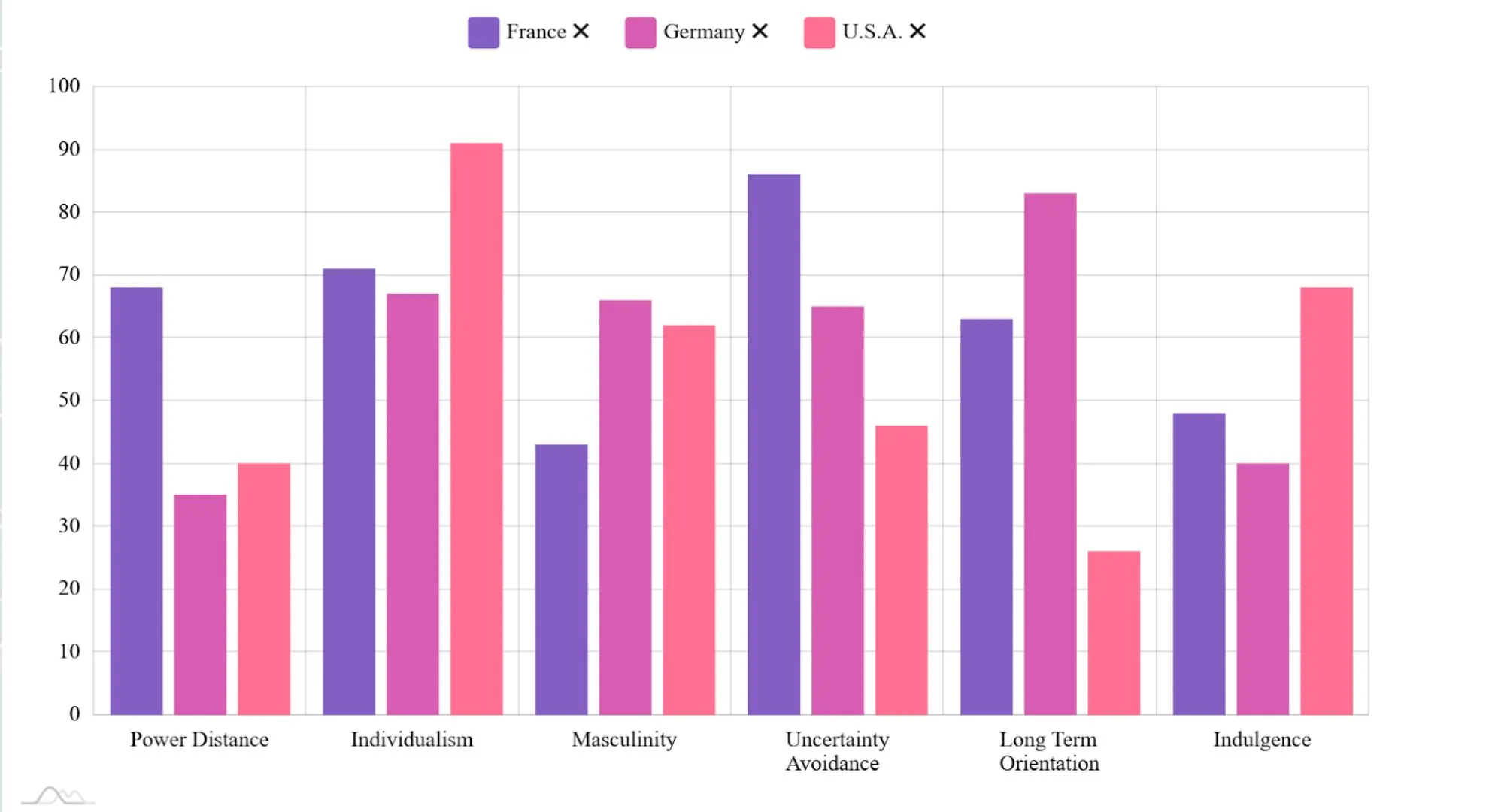
This chart compares the United States with Western European cultural patterns using Hofstede’s dimensions. Western Europe exhibits higher power distance and uncertainty avoidance, reflecting stronger hierarchy, a preference for structure, and greater risk aversion. The United States scores higher on individualism and indulgence, and lower on power distance and uncertainty avoidance, which supports faster decision-making, informal communication, and a stronger focus on short-term outcomes.
These patterns offer a practical explanation for how business behavior varies across regions.
Decision-making: why timelines break even when everyone agrees
Once communication establishes interest, the next challenge is the speed of decision-making. Many companies assume that agreement means a quick outcome, but decision-making is culturally structured and directly affects sales cycles, forecasting, and project planning.
- In the United States, decisions are fast and decentralized. Managers are expected to act, and taking calculated risks is part of the business culture.
- In Western Europe, decision-making typically involves analysis, internal alignment, and clearly defined approval processes.
- Northern Europe follows a strong consensus model, where decisions may take longer, but once agreed, execution is fast and stable.
- Eastern Europe is more flexible and situational. Decisions can be relatively rapid, especially in private companies, but authority is typically centralized.
- Southern Europe frequently combines hierarchy with relationship-based influence. Personal trust may affect both timing and outcome.
In cross-border projects, misaligned expectations regarding approval processes are a major source of delay. This is why the common perception that "Europe moves more slowly" is misleading: markets move differently, not necessarily more slowly.
Marketing perception: why the same campaign loses credibility
Marketing differences become clearer once communication style and decision logic are understood. Marketing is essentially communication at scale, and cultural expectations shape perceptions of credibility, professionalism, and trustworthiness.
- In the United States, persuasive messaging, strong differentiation, and urgency are widely accepted. Campaigns typically focus on personal benefit and rapid conversion.
- In Western Europe, credibility is built through evidence, professional tone, and a strong brand position.
- Northern Europe values transparency, sustainability, and authenticity. Messaging should be factual, modest, and socially responsible.
- Eastern Europe is highly pragmatic. Price–value balance, reliability, and practical benefits are strong decision drivers, while trust in the provider is also significant.
- Southern Europe responds more positively to relationship-driven and emotional messaging, particularly when it is supported by local presence or references.
As a result, the same campaign can perform very differently across European regions even when the language is identical, because each market applies its own credibility filters.
Recommended article
Trust: why competence is not always enough
At this stage, another pattern becomes visible. Even when communication is clear and the offer is strong, deals may still move slowly. The missing factor is often trust, which is built differently across cultures.
The Culture Map distinguishes between task-based and relationship-based trust.
In the United States, Germany, and much of Northern Europe, trust is primarily task-based. Competence, reliability, and measurable results come first. In France and Southern Europe, trust is more relationship-based. Personal connection and credibility over time influence business decisions.
Eastern Europe sits between these models. Professional competence is essential, but personal relationships frequently accelerate cooperation and reduce perceived risk.
This explains why some companies find it difficult to convert in Europe. They focus solely on expertise in markets in which relationship-building is integral to decision-making.
Timing and workflow expectations: why day-to-day cooperation feels "off"
Cultural differences do not disappear after a contract is signed. They continue to affect daily operations: response speed, planning horizons, meeting dynamics, and expectations regarding availability. These factors influence delivery quality and client satisfaction just as much as sales.
| Factor | U.S. | Western Europe | Eastern Europe | Northern Europe | Southern Europe |
|---|---|---|---|---|---|
| Response speed | Immediate | Structured and planned | Fast but situational | Planned and predictable | Variable |
| Planning horizon | Short-term | Long-term and process-driven | Medium-term, adaptive | Long-term | Flexible |
| Work-life boundaries | Flexible | Strongly protected | Moderate | Strongly protected | Protected |
These operational differences often translate into practical risks, including missed expectations, perceived delays, or unspoken frustration, even when both sides are competent and aligned on goals.
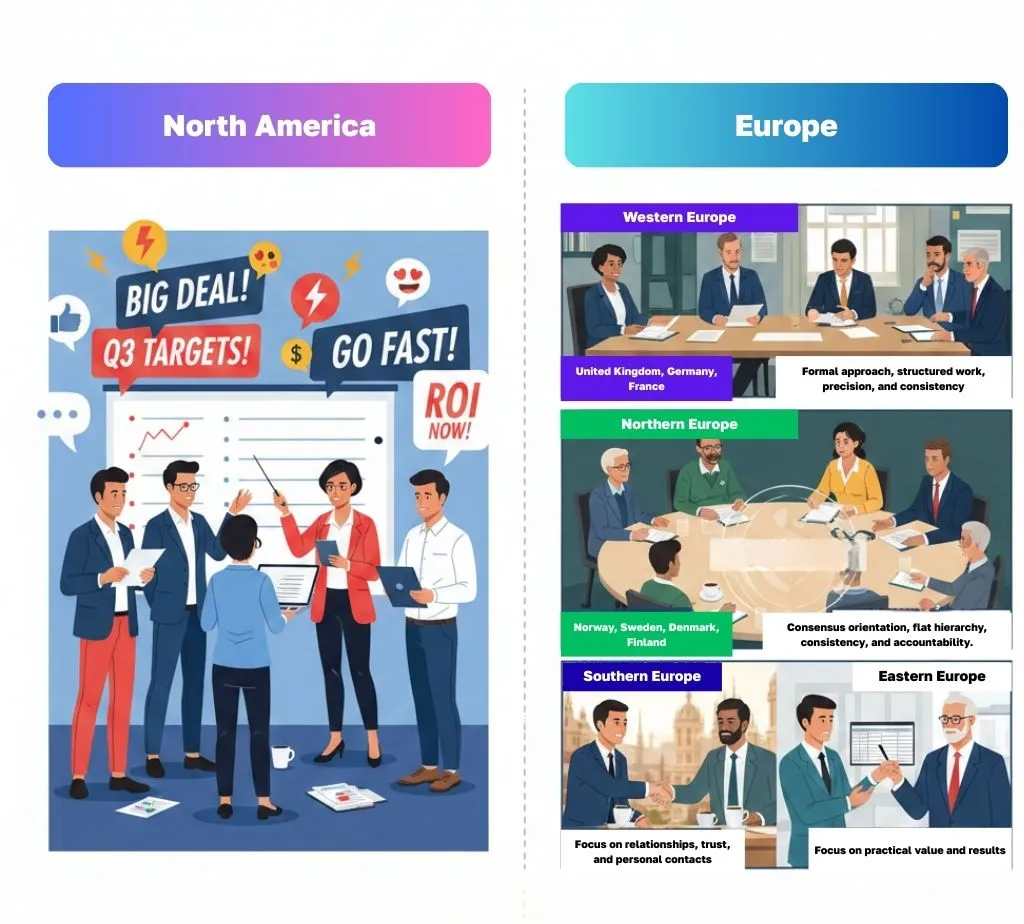
Key differences summary (so you can hold the model in one view)
After exploring communication, decision-making, marketing perception, trust, and workflow, it is useful to bring these patterns together into a single overview. The table below serves as a reference model rather than a simplification.
| Dimension | U.S. | Western Europe | Eastern Europe | Northern Europe | Southern Europe |
|---|---|---|---|---|---|
| Communication | Direct, informal | Structured, formal | Direct, pragmatic, semi-formal | Direct, modest | Contextual, personal |
| Decision-making | Fast | Structured, alignment-driven | Flexible, leadership-driven | Consensus-based | Relationship-influenced |
| Marketing | Benefit-driven | Credibility and proof-driven | Value-driven | Transparent, authentic | Emotional, relational |
| Trust | Task-based | Mostly task-based | Mixed | Task-based | Relationship-based |
| Risk attitude | High tolerance | Lower tolerance | Moderate | Low to moderate | Moderate |
Cultural differences between North America and Europe don’t live in "soft skills" — they show up in measurable business outcomes: how quickly partners respond, how decisions are made, what builds trust, and what makes marketing credible.
Successful international expansion depends on adapting business communication, decision-making expectations, and trust-building to regional norms. A more reliable approach is to think in cultural clusters: Western, Northern, Southern, and Eastern Europe, and adapt your communication, decision-making process, and marketing signals accordingly.
The Culture Map helps translate these differences into practical business behavior: low- vs. high-context communication, task- vs. relationship-based trust, consensus- vs. hierarchical decision-making, and different planning rhythms.
The good news is that cultural alignment is learnable. When go-to-market strategy and partner communication reflect these patterns, companies reduce friction, shorten cycles, and improve results across sales, marketing, and delivery.
Below are answers to the most common questions companies ask when entering European markets. Expect more articles on this topic soon. We’ll go deeper into specific regions and real business scenarios (emails, meetings, negotiations, and campaign examples) to help you apply these insights in practice.
FAQ: Cultural differences between North America and Europe in business communication
Why do U.S. business messages sometimes fail in Europe?
Because "clarity" is interpreted differently. In the U.S., directness and speed are positive signals. In parts of Europe, particularly in France and Southern Europe, tone, formality, and context affect credibility; thus, the same message may feel abrupt or overly transactional.
Is Europe one business culture?
No. Europe is better characterized by cultural clusters: Western, Northern (Nordics/Netherlands), Southern (Italy/Spain/Portugal), and Eastern (Poland/Ukraine/Romania). Each cluster differs in formality, decision speed, and the manner in which trust is built.
How do decision-making styles differ between the U.S. and Europe?
The U.S. tends to make faster, decentralized decisions. Germany and Northern Europe often require alignment and consensus, whereas France and some Southern European markets are more hierarchical, with senior leaders making final decisions.
Why do sales cycles often take longer in Europe?
Because decisions may require more internal alignment, risk evaluation, and stakeholder approval. In relationship-driven cultures, trust-building can be part of the decision process, so speed depends not only on the offer but also on credibility and relationship context.
Do marketing campaigns need to be different across European regions?
Yes. U.S. messaging often relies on strong differentiation, urgency, and emotional persuasion. Germany expects evidence and precision. Northern Europe values transparency and authenticity. France responds to brand positioning and tone. Eastern Europe is pragmatic and value-focused. Southern Europe is more relationship- and emotion-oriented.
What the difference between task-based & relationship-based trust in business?
Task-based trust (common in the U.S., Germany, and Northern Europe) is built through competence and results. Relationship-based trust (common in France and Southern Europe) relies more on personal connection and credibility over time. Eastern Europe typically combines both.
What is the simplest way to avoid misunderstandings in cross-border projects?
Align expectations early: communication style, decision authority, approval steps, and realistic timelines. This prevents "silent friction"; delays, misinterpretation of tone, and mismatched speed, even when both sides are motivated and professional.